

Oil Requirements
If the outboard will be operated in temperatures below freezing (32°F, 0°C), use Evinrude XD100.
Recommended Lubricants
Failure to follow these recommendations could void the outboard warranty if a lubrication-related failure occurs.
Evinrude XD100, or XD50 outboard oils are recommended for use in Evinrude E-TEC G2 out boards. If these oils are not available, use a TC W3 certified SYNTHETIC oil.
Evinrude XD100 outboard oil is highly recommended for all conditions and applications.
Checking Oil Level
Make sure the outboard is in the vertical position when checking oil level. Use the digital gauge or display to check the oil level.
Optional Remote Oil Tank Kits
The following optional accessory kits are available for use with Evinrude E-TEC G2 models:
- Remote Oil Tank Kit, 1.8 gallons (6.8 liters), P/N 5008571
- Remote Oil Tank Kit, 3.0 gallons (11.3 liters), P/N 5008572
- Oil Tank Pick-up Kit, P/N 767686, for the 10 gallon (37.8 liters) capacity oil tank.
Components
The oiling system consists of the following components:
- Oil tank
- Crankcase oil pump and manifold assembly
- Electrical circuit
- Oil level sender
- LOW OIL switch
- LOW OIL and NO OIL warning systems
- Cylinder oil pump and manifold assembly
- Oil recirculation system
Oil Tank Assembly
The oil tank is located on the starboard side of the engine and the oil level must be monitored.
Oil Tank Components:
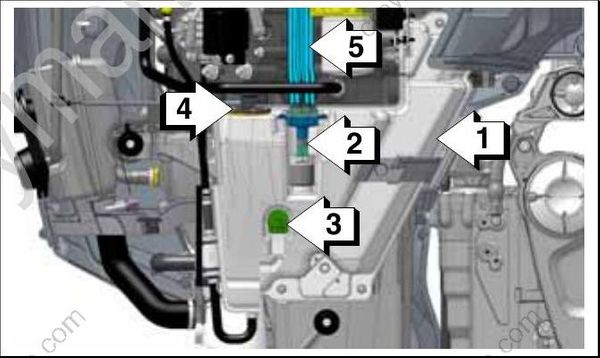
Oil Tank Assembly
- Tank, 2.0 gallon capacity
- Oil pickup and filter assembly
- LOW OIL switch
- Oil level sender
- Oil distribution hoses
Crankcase Oil Pump
The crankcase oil pump is an electric actuator style pump. The EMM supplies 55 V and controls activation of the pump. The pump draws oil from the oil tank and supplies pressurized oil to the oil manifold.
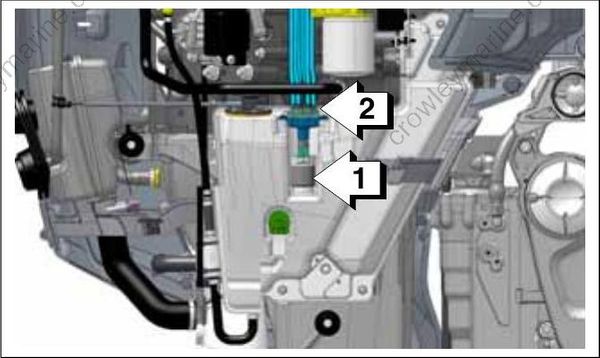
- Oil pump
- Oil manifold
The oil manifold distributes the oil supplied by the oil pump to the crankcase.
Electrical Circuit (55 V)
The oil pump is powered by the 55 V electrical circuit. The EMM controls pump operation by rapidly connecting and disconnecting the pump’s internal coil to ground.
The EMM monitors the oil pump electrical circuit. If the EMM detects an open circuit in the harness or oil pump, the EMM:
| Activates S.A.F.E. |
|---|
| Stores fault code 34 |
| Engine Monitor NO OIL display: ON |
Cylinder Oil Pump
The cylinder oil pump is an electric actuator style pump. The EMM supplies 55 V and controls activation of the pump. The pump draws oil from the oil tank through a hose and filter assembly and supplies pressurized oil to the oil manifold.
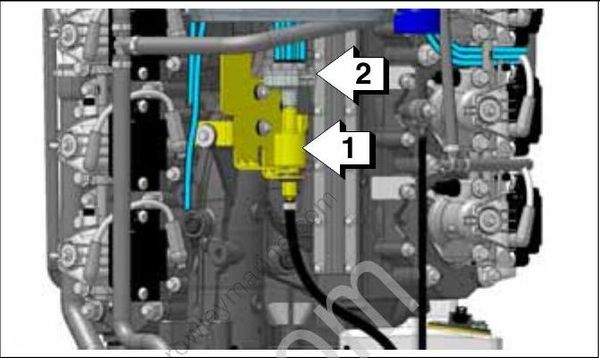
- Oil pump
- Oil manifold
The oil manifold distributes the oil supplied by the oil pump to the cylinder sleeves.
Electrical Circuit (55 V)
The cylinder oil pump is powered by the 55 V electrical circuit. The EMM controls pump operation by rapidly connecting and disconnecting the pump’s internal coil to ground.
The EMM monitors the oil pump electrical circuit. If the circuit is open, the EMM:
| Activates S.A.F.E. |
|---|
| Stores fault code 34 |
| Engine Monitor NO OIL display: ON |
Oil Level Sender
An oil level sender mounted in the oil tank monitors oil level and transmits oil level information to a NMEA 2000 network.
If equipped with ICON Touch digital displays, the oil level sender signals the ICON Touch display to activate the LOW OIL warning through a NMEA2000 network. See LOW OIL Warning on p. 194.
LOW OIL Switch
An oil level switch in the oil tank assembly monitors the oil level in the oil tank.
Oil Warning System
LOW OIL Warning
If the oil level falls below 25% capacity, the EMM signals:
| Engine Monitor LOW OIL display: ON |
|---|
Approximate oil reserve at LOW OIL activation is 2.0 qt. (1.9 l).
If equipped with ICON Touch digital dis plays, the sending unit in the oil tank signals the ICON Touch display to activate the LOW OIL warning through a NMEA2000 network.
NO OIL Warning
When the oil level falls below 25%, the EMM begins counting oil pump pulse cycles. When it reaches:
- 20,000 pulses the EMM:
| Activates S.A.F.E |
|---|
| Stores fault code 117 |
| Engine Monitor NO OIL display: ON |
To recover from S.A.F.E. mode:
- Oil level must be above 25%
- The warning resets after three oil pump pulse cycles when the outboard has been stopped and restarted.
If outboard has been run for more than 5 hours with NO OIL faults (codes 34 & 117), the EMM:
| Activates SHUTDOWN |
|---|
| Stores fault code 33 |
| Engine Monitor NO OIL display: FLASHING |
Cylinder and Crankcase
The crankcase oil manifold provides crankcase lubrication through oil distribution hoses and pressed-in fittings at the front of the crankcase, starboard side.
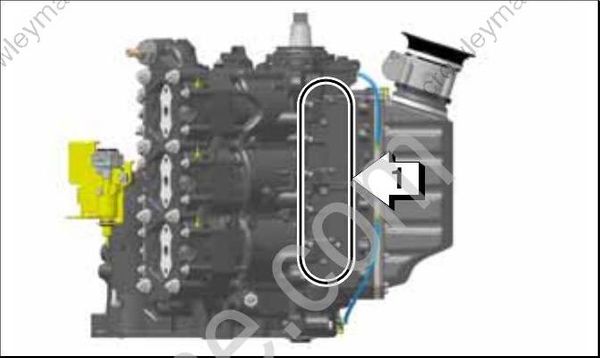
- Pressed-in fitting
The cylinder oil pump and manifold provides lubrication for each cylinder. Each cylinder of the cylinder/crankcase has a pressed-in fitting which is connected to an oil distribution hose.
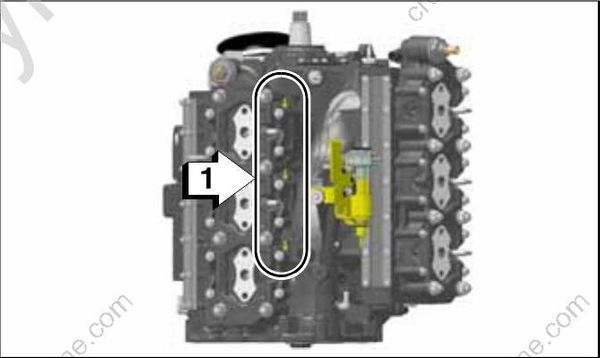
- Cylinder sleeve oil fittings – port/rear
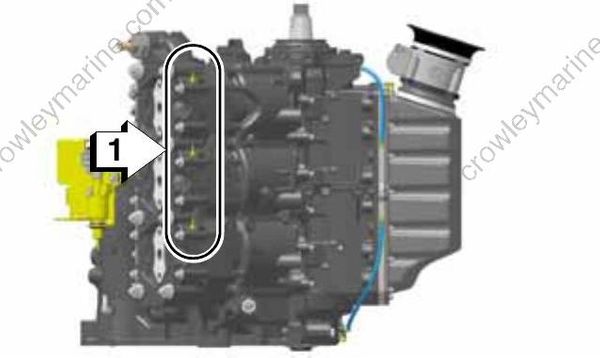
- Cylinder sleeve oil fittings – starboard
Oil Recirculation System
External hoses and fittings, internal cylinder/crankcase passages, and intake manifold pas sages are used to recirculate any accumulation of oil from various locations in the powerhead. The movement of oil is controlled by check valves.
Crankcase / Main Bearing Recirculation
The movement of oil through the main bearings is controlled by internal passages, external fittings and hoses, and an in-line check valve.
Both center main bearings receive oil through grooved passages in the crankcase. Oil migrates to the bearings from the crankcase areas of the higher cylinders.
The lower main bearing receives oil through:
- a check valve and internal passage from the area inside the plenum
- a check valve and external hose from the reed plate of cylinder number 4
- a check valve and internal passage from the reed plate of cylinder number 5
- a check valve and internal passage from the reed plate of cylinder number 6
The upper main bearing receives oil through a check valve and external hose from the reed plate of cylinder number 2.
Lower to upper main bearing oil flow
Oil moves from the lower main bearing cavity through an internal crankcase passage to an external fitting. External hoses with an in-line check valve connect to a fitting at the upper main bearing, which leads to the upper main bearing through an internal crankcase passage.
Break-In Oiling
The operator must monitor the oil tank level to confirm oil consumption. This may require several hours of operation above idle.
IMPORTANT: DO NOT add oil to the fuel tank on Evinrude E-TEC models.
The EMM automatically supplies extra oil to the engine for the first two hours above 2000 RPM.
Follow these steps for outboard set-up:
- Use Evinrude Diagnostics software, v 6.1 or higher to make sure the break-in program has been started.
- Use the diagnostics software to start break-in oiling after a powerhead rebuild.
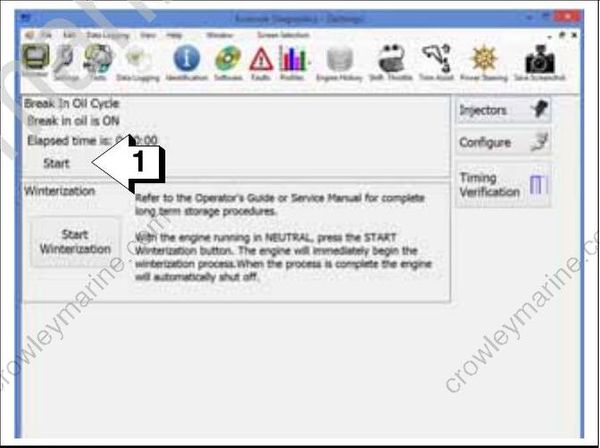
Settings Screen
- Break-in oil setting
