

Tiller Handle
Lubricate the tiller handle grease fittings with Triple-Guard grease.
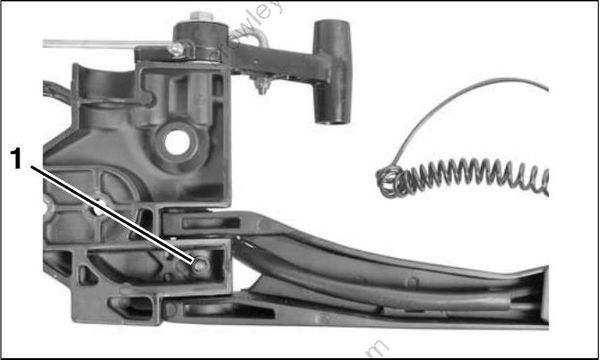
- Tiller handle fittings – Standard handle
Swivel Bracket and Trailering Bracket
Lubricate the swivel bracket with Triple-Guard grease.
Apply grease until the grease begins to flow from the upper or lower swivel bracket areas.
Coat the pivot points of the trailering bracket with Triple-Guard grease.
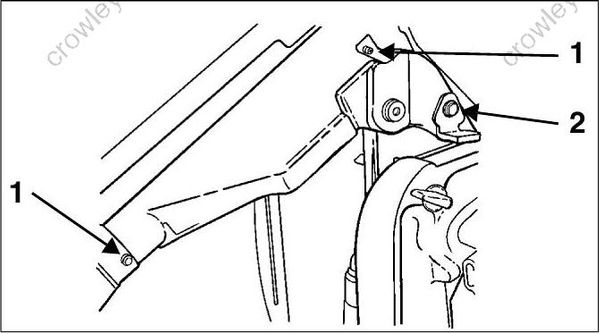
- Grease fitting
- Tilt support
Tilt Tube
Lubricate the tilt tube grease fittings with Triple Guard grease.
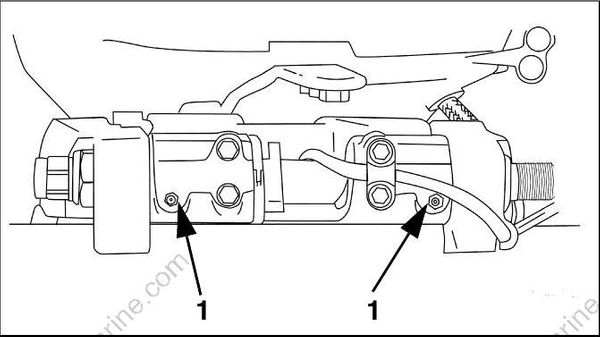
- Tilt tube fittings
Throttle and Shift Linkage
Remove throttle control cable and shift rod from lever pins.
Twist throttle grip to FULL THROTTLE position to fully extend the cable.
Apply Triple-Guard grease to:
Cable attachment pins of both the throttle and shift levers.
Inner casing of the throttle cable.
IMPORTANT: Do not lubricate throttle levers or shoulder screws.
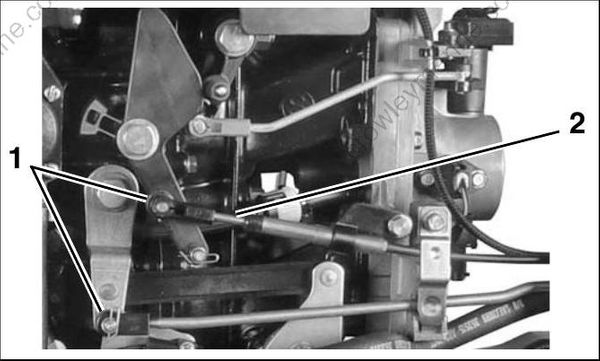
- Attachment pins, throttle and shift
- Inner casing, throttle cables
Return controls to the NEUTRAL/IDLE position. Install throttle cable a nd shift rod on lever pins. Check proper throttle and shift function.
Throttle Plate
Lubricate the throttle plate as required to prevent corrosion build-up. S pray 6 in 1 Multipurpose Lubricant thro ugh hole in air silencer for 3 to 5 seconds.
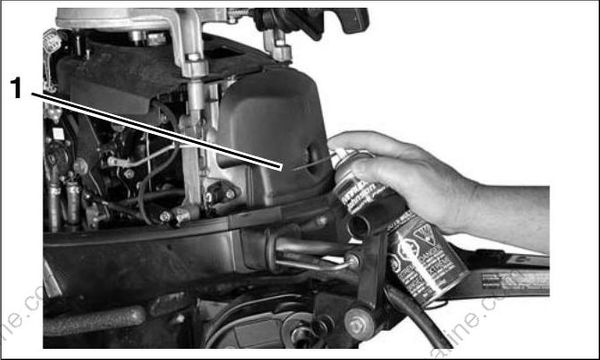
- Air silence lubrication hole
Propeller Shaft (MRL)
Debris from the water can become lodged around propeller shaft. Frequent inspection can minimize potential gearcase damage.
When servicing the propeller, always shift the outboard to NEUTRAL, twist and remove all spark plug leads so the outboard cannot be started accidentally.
Remove propeller. Refer to Propeller Hardware Installation on p. 42.
Inspect bushing a nd blade surfaces. Replace damaged or worn propellers.
Clean propeller shaft. Inspect propeller shaft seals. Replace damaged or worn seals.
Apply Triple-Guard grease to entire length of propeller shaft prior to installing propeller.
Reinstall propeller hardware and propeller.
Gearcase Lubricant
Draining
Gearcase lubricant may be under pressure and/or hot. If plug is removed from a recently operated outboard, take precautions to avoid injury.
IMPORTANT: Always check the fill level of the gearcase lubricant at the upper plug before removing the lower, drain/fill plug. A tie strap can be used to check lubricant level.
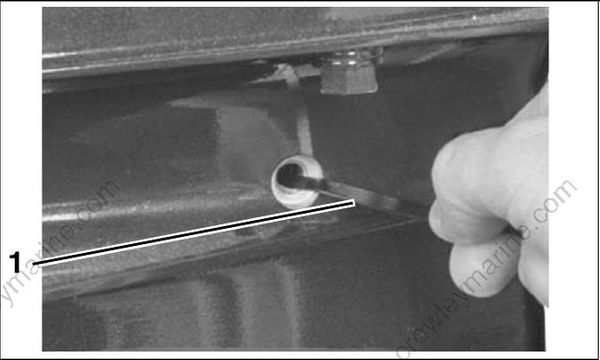
- Tie strap
If lubricant level is low, refer to GEARCASE LEAK TEST on p. 238.
Remove the lubricant level plug, then the lubricant drain/fill plug, and drain the oil from the gearcase into a suitable container.
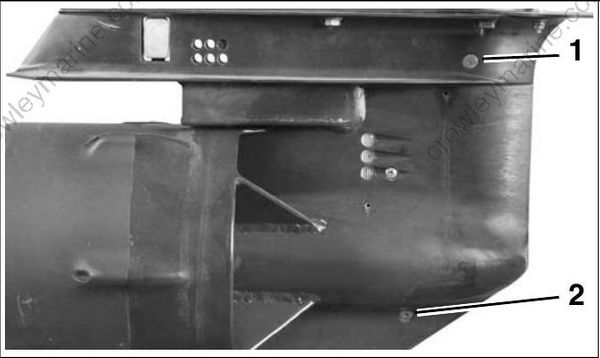
- Lubricant level plug
- Lubricant drain/fill plug
Inspection
Inspect the lubricant a nd the magnet s on the plugs for metal chips. The presence of metal fuzz can indicate normal wear of the gears, bearings, or shafts wit hint he gearcase. Met al chips can indicate extensive internal damage.
Inspect the lubricant for water contamination. Water can make the lubricant milky in appearance. However, normal ae ration c an also cause the same appearance.
To check for water contamination, put lubricant into a glass container. Allow the oil to settle for a minimum of one hour to determine if there is an abnormal amount of water in the oil.
If water is present, refer to GEARCASE LEAK TEST on p. 238.
Overheated lubricant will have a black color and burned odor.
Internal gearcase inspection is recommended when lubricant is contaminated or shows signs of failure.
Filling
Refer to the INSPECTION AND MAINTENANCE SCHEDULE on p. 56 for service frequency and recommended lubricants.
Secure the gearcase in a vertical position.
Remove the lubricant level plug and the lubricant drain/fill plug.
Use Gearcase Filler, P/N 501882, to slowly fill the gearcase with HPF PRO lubricant through the drain/fill hole until it appears at the oil level hole.
IMPORTANT: Filling the gearcase too quickly can cause air pockets and the gearcase may not fill completely.
Clean plug seal area and install the lubricant level plug and new seal, then the lubricant drain/fill plug and new seal. Tighten plugs to a torque of 60 to 84 in. lbs. (7 to 9.5 N·m).
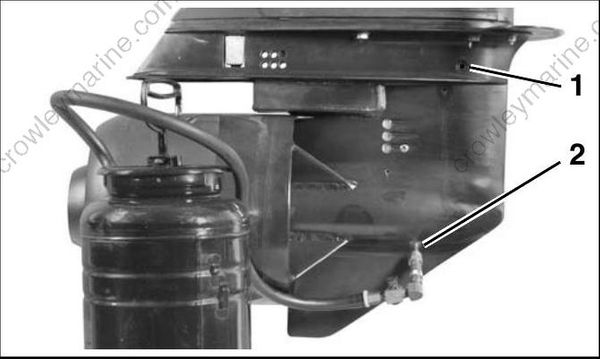
- Lubricant level plug
- Lubricant drain/fill plug
IMPORTANT: The recommended gear lubricants are formulated for marine applications. Do not use automotive gear lubricants, engine oils, or
any other oil or grease.
