BATTERY REQUIREMENT
Suzuki recommends a 12-volt cranking-type lead acid battery for the DF100A/115A/140A. Minimum battery requirement for starting the engine is provided below.
The battery must satisfy one of the specifications described below.
650 Marine Cranking Amps (MCA)/ABYC,
or 512 Cold Cranking Amps (CCA)/SAE
or 160 Reserve Capacity (RC) Minutes/SAE
or 12 V 100 AH
• The specifications listed above are the minimum battery rating requirements for starting the engine.
• Additional electrical loads from the boat will require larger capacity batteries.
• Dual-purpose (Cranking/Deep Cycle) batteries can be used if they meet the minimum specifications listed above (MCA, CCA, or RC).
• Do not use a Deep Cycle battery for the main cranking battery.
• The use of Maintenance-Free, sealed, or Gel-Cell batteries is not recommended because they may not be compatible with Suzuki’s charging system.
• When connecting batteries in parallel, they must be of the same type, capacity, manufacturer, and of similar age. When replacement is necessary, they should be replaced as a set.
INSTALLATION OF BATTERY
Failure to take proper precautions when handling the battery may cause severe injury.
Be sure to take the following precautions when handling the battery:
• Never expose the battery to open flames or electric sparks as batteries generate gas which is flammable and explosive.
• Do not place the battery near the fuel tank.
• Battery acid is poisonous and corrosive. Avoid contact with eyes, skin, clothing and painted surfaces.
If you come in contact with battery acid, flush immediately with large amounts of water and seek immediate medical attention.
• Batteries should always be kept out of reach of children.
• When checking or servicing battery, disconnect the negative (black) cable. Be careful not to cause a short circuit by allowing metal objects to contact the battery posts and motor at the same time.
• Wear approved eye protection.
Store the battery free from splash of water, etc. and fix it securely to the hull with a battery band or the like to prevent it from falling down during boating.
It is recommended that the battery be installed in an enclosed battery case.
In the case of twin installation, be sure to use a battery for an engine respectively.
When extending the battery cable, use a cable of diameter larger than equivalence of AV20 (AWG4).
CONNECTION OF BATTERY CABLE
- First connect positive battery cable to positive battery terminal, then connect negative battery cable to negative battery terminal.
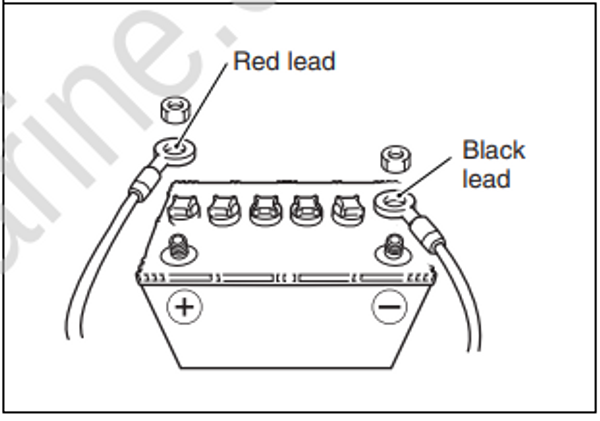
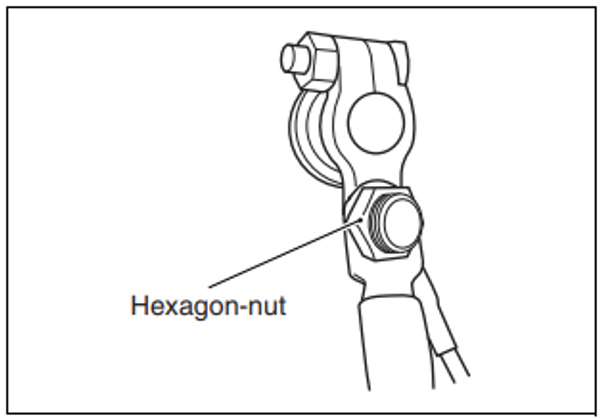
When connecting batteries, hexagon-nuts must be used to secure battery leads (cables) to battery terminals.