

STATOR TESTS
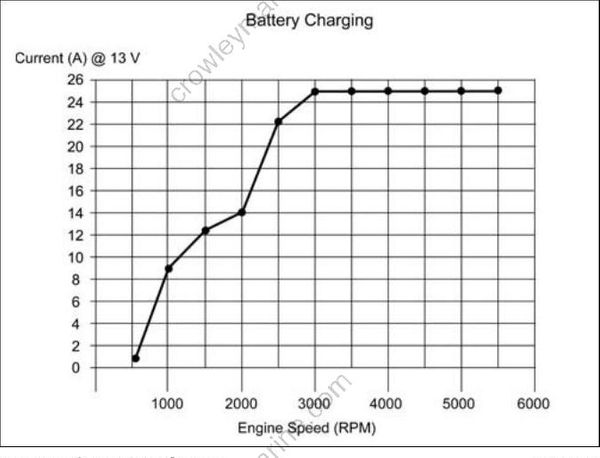
The stator consists of 3 windings (4 poles each) on a 5 inch diameter core and gene rates an out put voltage of 55 VAC (1 100 watt s maximum). This voltage is converted by the EMM to provide 12 VDC for battery charging (3 to 5 A at 500 RPM and 25 A from 3000 RPM to WOT ) and 55 VDC for fuel injector, and fuel and oil pump operation.
Stator Resistance Tests
Use a digital multimeter to check resistance of stator windings.
Disconnect EMM J2 connector from EMM.
| Stator Winding Resistance Specification |
|---|
| Yellow & Yellow / white |
| .670 ± 0.020 Ω @ 73°F (23°C) |
| Brown & Brown / white |
| .670 ± 0.020 Ω @ 73°F (23°C) |
| Orange & Orange / white |
| .670 ± 0.020 Ω @ 73°F (23°C) |
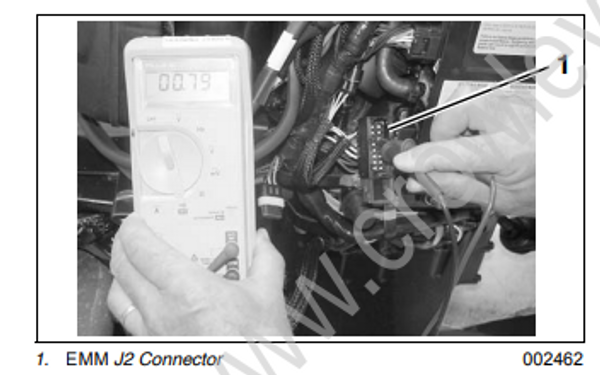
- EMM J2 Connector
Connect meter leads to the following pins:
- Yellow/white and yellow (pins 9 and 1)
- Brown/white and brown (pins 10 and 2)
- Orange/white and orange (pins 11 and 3)
IMPORTANT: A reading of less than 2 ohms is acceptable. Make sure meter is calibrated to read 1 ohm or less.
To check for a g rounded winding, connect on e meter lead to ground and alternately connect the other meter lead to each stator wire. Meter should read no continuity. If meter rea ds continuity, replace stator.
Stator Voltage Output Test
ELECTRIC START MODELS
Use a digit al multimeter to check stator output voltage. Set meter to read 110 VAC output.
To prevent accidental starting of outboard, disconnect crankshaft position sensor (CPS).
Disconnect CPS.
Disconnect stator (6-pin) connector from the engine harness (6-pin) connector.
Connect Stator Test Adaptor tool, P/N 5005799, to stator connector.
Connect meter leads to terminals of adaptor tool. With a fully charged battery, crank outboard (300 RPM minimum) and observe meter reading:
- 30 VAC at 300 RPM
- 40 VAC at 400 RPM
• 55 VAC above 500 RPM
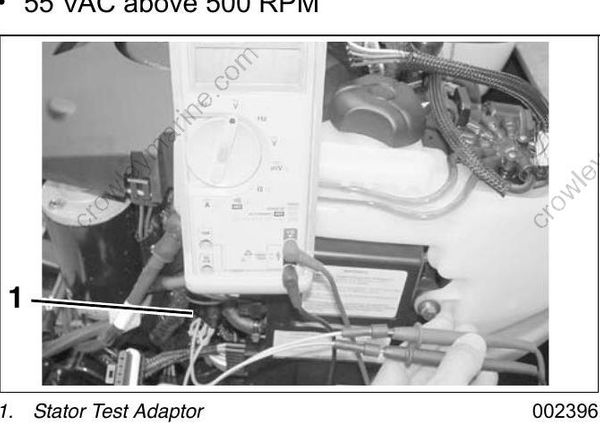
002396
- Stator Test Adaptor
ROPE START MODELS
Use a Pea k Reading Voltmeter, P/N 507972, to check stator output volt age. Set meter to the 50 VAC scale.
To prevent accidental starting of outboard, disconnect crankshaft position sensor (CPS).
Disconnect CPS. Remove spark plugs. Make sure to SPARK outboard is in NEUTRAL. Refer PLUGS on p. 42.
Disconnect stator (6-pin) connector from the engine harness (6-pin) connector.
Connect Stator Test Adaptor tool, P/N 5005799, to stator connector.
Connect meter leads to terminals of adaptor tool. Rotate the flywheel with the starter rope, using a long, steady pull.
Stator output voltage should be approximately 30 VAC.
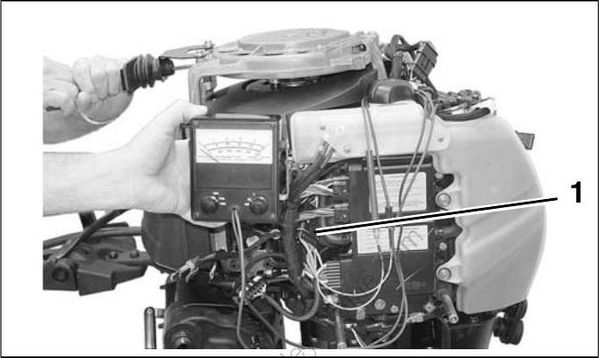
006750
- Stator Test Adaptor
IMPORTANT: Index all spark plugs. Refer to Spark Plug Indexing on p. 42.
CHARGING SYSTEM TESTS
12 V Charging Circuit
To test the operation of the regulator in the EMM, you must be able to run the outboard continuously at approximately 5000 RPM, such as in a test tank or on a marine dynamometer.
The test consist s of monitoring the system’ s response to a partially discharged battery. Use a variable load tester to discharge the battery.
IMPORTANT: The regulator requires voltage to operate. Before proceeding, make sure there is at least 7 V on the positive terminal of the starter solenoid.
Disconnect the battery cables at the battery.
Use an inductive amp meter or connect a 0 to 50 A ammeter in series between the red wire of engine wire harness (alternator output from EMM) and the positive (B+) battery cable terminal of starter solenoid. Fluke
- model 334 or 336, Snap-On
- model MT110 or EETA501, and various other amp meters should be available through local tool suppliers. Reconnect the battery cables.
Following the manufacturer’s directions, connect the variable lo ad teste r (carbon pile) across the battery terminals. Stevens model LB-85 a nd Snap-On model MT540D are examples o f testers available.
Excessive battery discharge rates might overheat battery causing electrolyte gas- sing. This might create an explosive atmosphere. Always work in a well ventilated area.
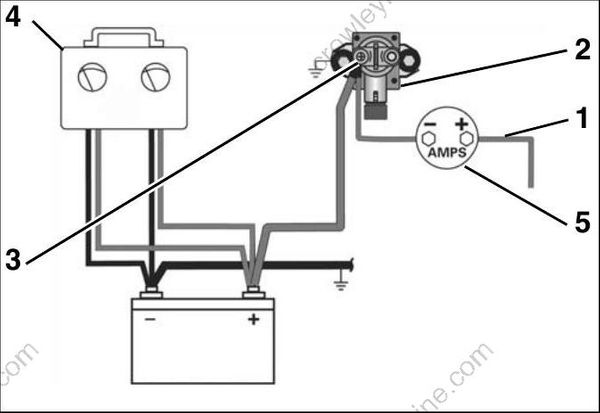
002077
Variable Load Test Diagram
- Red wire (alternator output from EMM)
- Starter solenoid
- Battery cable terminal (B+)
- Variable load tester
- Ammeter
002076
Battery Charging Graph
Start and run the outboard at approximately 5000 RPM. Use the variable load tester to draw the battery down at a rate equivalent to the stator’s full output.
- The ammeter should indicate nearly full output, approximately 25 A @ 5000 RPM. Decrease the battery load toward 0 A.
- Ammeter should show a reduced output. As the current draw decreases, the battery volt age should stabilize at approximately 14.5 V.
- If results vary, check stator BEFORE replacing the EMM. Refer to STATOR TESTS on p. 97.
55 V Alternator Circuit
Check battery ground cable for continuity.
With the key switch ON, check battery voltage at battery (12 V).
Then, use Electrical Test Probe Kit, P/N 342677, and a digital multimeter set to read 55 VDC to check voltage on white/red wires a t J2 connector of EMM. Voltage at EMM connector should be 0.5 to 1 V less than battery.
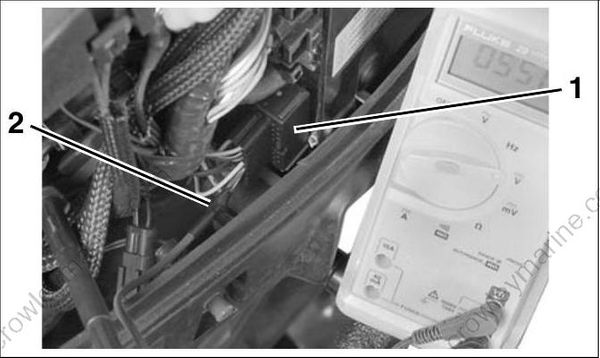
007261
- J2 connector
- Test probe
With outboard running a t 1 000 RPM, voltage o n white/red wires should be 55 V. Voltage readings at a specific speed (RPM) should be steady.
If there is any other reading, refer to STATOR TESTS on p. 97. Inspect the stator wiring an d connections. Inspect the capacitor wiring, connections, and capacitor. Repair the wiring or replace a faulty capacitor, stator, or EMM.
