OIL PRECISION SYSTEM
As with any oil injection system equipped engine, there is no need to pre-mix oil and gasoline when refilling; oil and gasoline are fed to the engine from separate tanks.
This system provides the perfect mix of oil to gasoline for every speed.
CAUTION: For the first hours of use, pre-mixing will be necessary, the mixture is 50:1 gaso-line/oil.
(1)Features
1) No need to pre-mix oil and gasoline.
2) The amount of oil for injection is decided by sensing changes in the opening of the throttle, and engine speed (crankshaft RPM).
The oil is injected into the intake manifold, and the mixture varies from 200 : 1 (for low speeds and idling) to 50 : 1 (for high speeds). Since the amount of oil is decided according to the actual needs of the engine, and does not depend on a pre-mix, there is less waste in oil consumption, and better protection for the engine. Not only does the engine receive the proper amount of oil, but with efficient burning, there is less carbon build up.3) The combination of main and sub oil tanks allows a total of 11.35 liters (3.0 US gal) of oil to be stored. The main tank contains 0.85 liters (0.22 US gal) and is included in the body of the motor.
The sub-tank contains 10.5 liters (2.77 US gal) and is kept separately in the boat.4) Oil level warning system
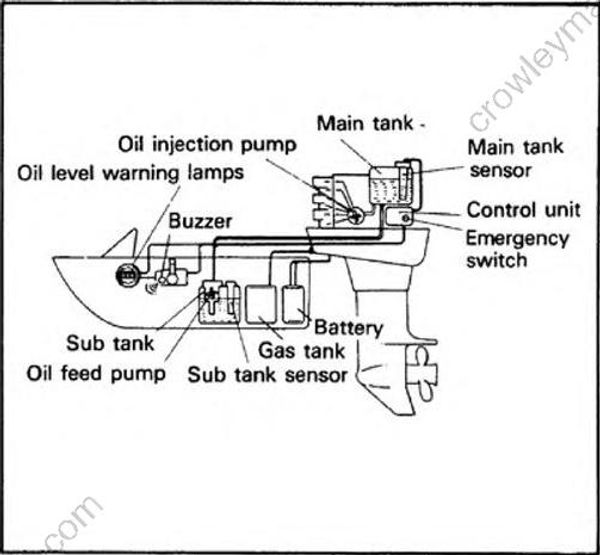
The various sensors set to determine the oil level in both the main and sub tanks send signals to circuits which operate three warning lamps; green, yellow and red, and a buzzer.The sensor in the main tank also serves to determine when it is necessary to pump up oil from the sub tank.
(2) Operation
- 1) Sub tank
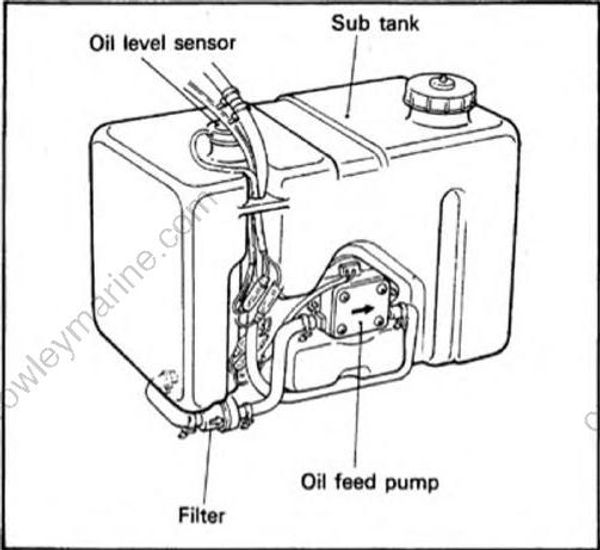
Placed in the boat, this tank stores 10.5 liters (2.77 US gal) of oil, making possible long trips without having to refill.
- 2) Oil feed pump
This gear type pump is connected to the oil level sensor in the main tank, and is activated to send oil up to the main tank when the oil level in the main tank is less than 500 cc (16.9 US oz).
However, it will not operate if there are only 1.5 litres in the sub tank. Once the main tank is full, the pump will cease operation.
- 3) Sub tank sensor
When the oil level in the sub tank reaches 1.5 liters (0.4 US gal), the sensor activates the yellow lamp so that the operator knows to refill the sub tank. Once the oil level returns to above 1.5 liters (0.4 US gal), the green lamp will come on again and the yellow one will go out.
Oil level in sub tank:
Below 1.5 liters (0.4 US gal) — Yellow lamp goes on.
Above 1.5 liters (0.4 US gal) — Green lamp goes on.
NOTE: The oil level can change depending on the method of installation and the angle of the boat during operation.
- 4) Main tank sensor
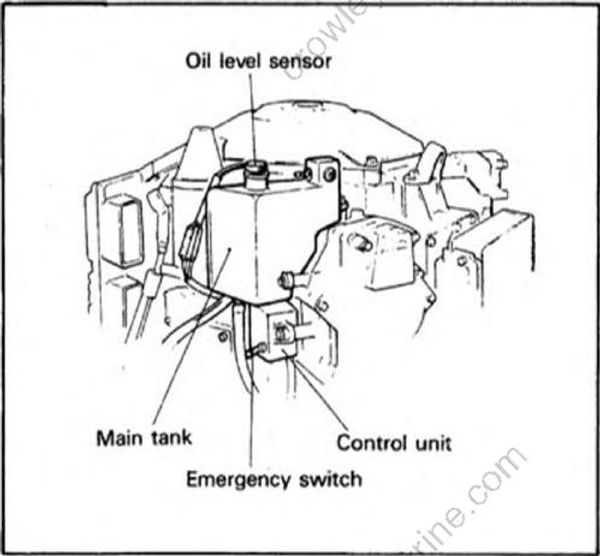
The sensor in the main tank not only activates the pump in the sub tank when oil is needed, but also is connected to the warning system, and therefore will activate the warning lamps when there is not enough oil. When there are 1.5 liters (0.4 US gal) of oil in the sub tank:
The sensor of the main tank will activate the pump in the sub tank when there are only 500 cc (16.9 US oz) of oil in the main tank. Then, when the amount of oil in the main tank reaches 850 cc (28.7 US oz), the sensor will signal to the circuit to stop the pumping.
When there is less than 1.5 liters (0.4 US gal) in the sub tank:
Even if the amount of oil in the main tank reaches 500 cc (16.9 US oz), the pump cannot be activated by the sensor of the main tank. And, when the oil in the main tank reaches the 350 cc (11.8 US oz) level, then the red warning lamp goes on and the buzzer in the remote control box sounds. When this happens, the operator must stop the engine and refill the sub tank.
Emergency switch:
In case it is impossible to put more oil in the sub tank, the emergency switch can be put on ON, and the pump in the sub tank will be activated to bring up more oil from the remaining 1.5 liters (0.4 US gal).
However, be aware that if all the oil in the sub tank is pumped to the main tank, the oil feed pump will probably have to be air bled before it can pump oil again.
Be careful not to pump too much, spillage from the main tank will occur.
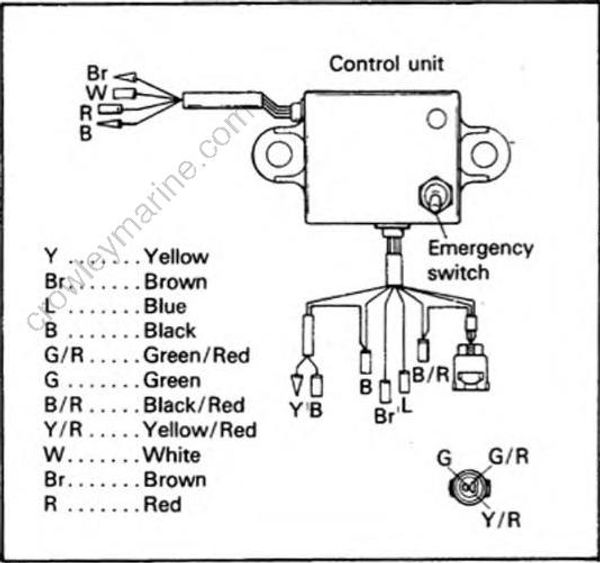
- 5) Control unit and emergency switch
The sensors in the main and sub tanks not only control the amount of oil in the main tank, but also advise the operator of the need for refilling. Also, since there is the possibility that when the motor is tilted up the sensor might be activated due to a change in oil level, thus causing unnecessary pumping and possibly overflow, the control unit includes a circuit to stop the oil feed pump of the sub tank from operating when the motor is tilted over 35°.The pump will work again when the tilt angle is less than 20°. The emergency switch is provided so as to be able to operate the oil pump to the main tank manually. It is used in the following situations:
(1) When the yellow or red warning lamps go on.
(2) When there is trouble with the control unit.
(3) When there is trouble with the sensors (due to tilting, etc.) Be sure to watch main tank as it fills when you use the emergency switch, as it may over flow. Stop engine before using switch, or close throttle completely.
- 6) Oil level warning lamps
Below is the explanation of what each warning lamp means, and what should be done when they come on.
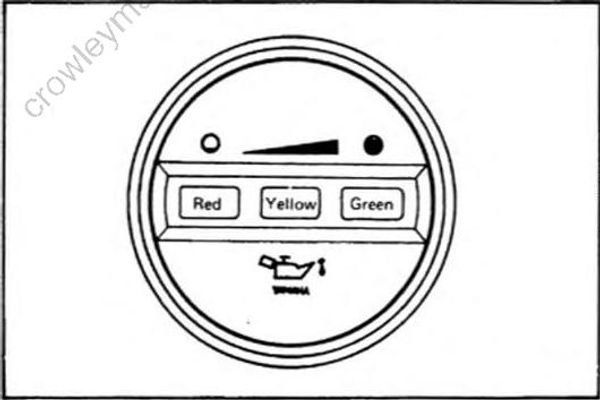
| 1 Green | More than 1.5 liters (0.4 US gal) in sub tank. More than 500cc (16.9 USoz) in main tank |
No need for oil refill, operation possible. |
|---|---|---|
| 2 Yellow | Less than 1.5 liters (0.4 US gal) in sub tank. | No oil reserve. Refill sub tank as soon as possible. |
| 3 Red | Less than 1.5 liters (0.4 US gal) in sub tank. Less than 350cc (11.8 US oz) in main tank. |
Danger, must refill sub tank. Almost no oil left. Stop engine and refill with oil. |
| 4 Green and Red | More than 1.5 liters (0.4 US gal) in sub tank. Put less than 350cc (11.8 USoz) in main tank. |
Danger, must refill main tank. Check oil feed pump and related parts. For some reason oil in sub tank is not reaching main tank. |
NOTE: In the case that the warning lamp system does not work, no lamp will come on. If this happens, it will be necessary to check the oil level immediately.
- 7) Overheat and oil level warning lights
Part of the electrical circuit is used to operate the buzzer and slow down the engine when the engine overheats.
Should the engine overheat, the overheat and oil level warning circuit operates as follows:
| Oil level warning light | Description |
|---|---|
| Green | The buzzer sounds and the engine slows down. |
| Yellow | The yellow light goes off, the buzzer sounds, and the engine slows down. |
| Red | The light changes from yellow to red, and after a whiles both yellow and red lights come on. The buzzer sounds and the engine slows down. |
- 8) Operation of the overheat and oil level warning system
- Filling with oil before engine delivery
- 1) Fill the sub-oil tank with oil.
- 2) Turn on the main switch.
Both red and green lights come on and the buzzer sounds.
The oil feed pump automatically operates and sends oil to the main oil tank.
CAUTION: When the main oil tank is topped up, the oil feed pump stops but both red light and buzzer remain turned on.
- 3) Turn off the main switch.
The red light comes off and the buzzer stops.
NOTE: Make sure the main oil tank is topped up.
- When the red light is on
- 1) Turn off the main switch to stop the engine.
- 2) Top up the main and sub-oil tanks.
- 3) Turn on the main switch, and make sure the red light remains turned off.
- 4) Turn the main switch to START to start the engine.
- When the emergency switch needs to be used
1) The buzzer sounds and the red light comes on.
2) Turn off the main switch to stop the engine.
3) Turn on the main switch, and then turn on the emergency switch so that oil is pumped up to the main oil tank from the sub-oil tank.
NOTE: The red light comes on and the buzzer sounds.
4) Turn off the main switch, and turn it on again, the make sure both red light and buzzer are turned off.
5) Set the main switch to START to start the engine.
NOTE: If the battery cable is disconnected, the system may not operate correctly. Use care so that the battery cable will not come off terminals.
9) Lamps and change in oil level (Main switch is ON)
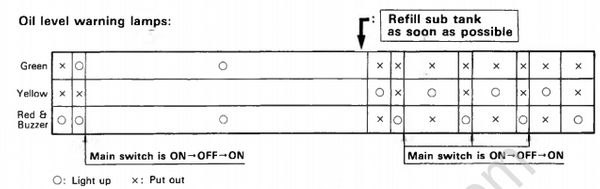
Oil level warning lamps:
Refill sub tank as soon as possible
O: Light up x : Put out
Main tank:

Sub tank:

Oil feed pump:

: Operation by emergency switch O: Run x : Stop
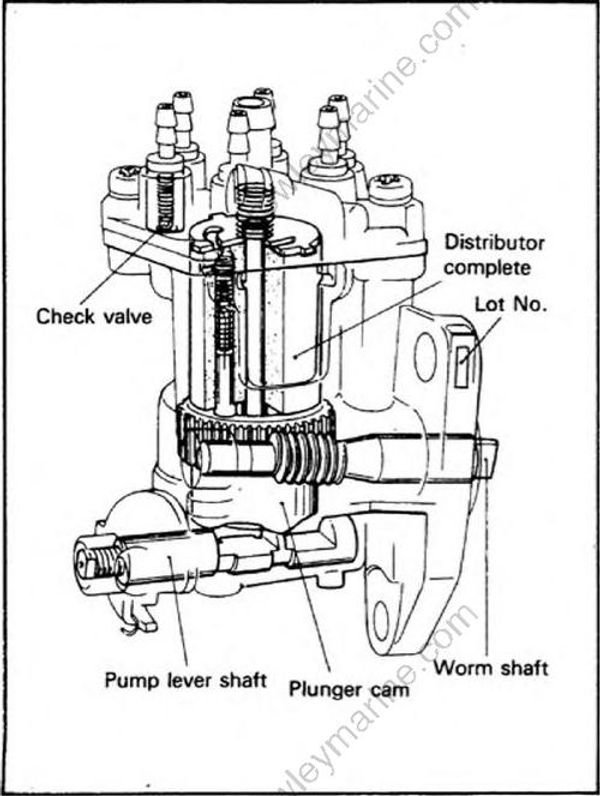
10)Oil injection pump
The oil injection pump sends the measured amount of oil to be injected directly into the intake manifold, where, it enters the intake port together with the mixture and lubricates the cylinders and the crank case journal.
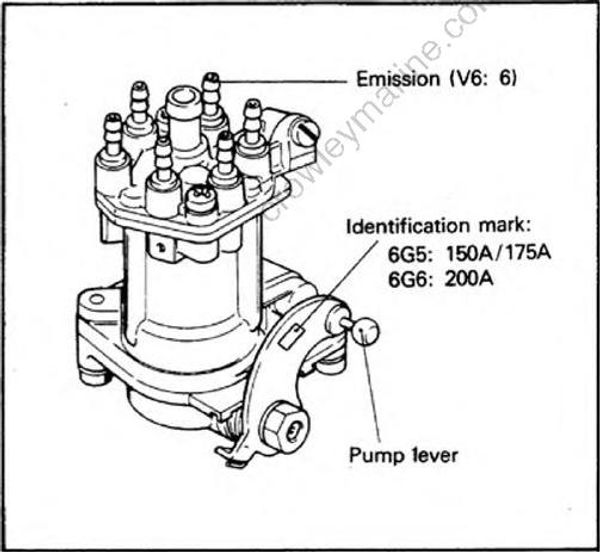
Operation
(1) The worm shaft of the oil pump is driven by a drive gear pressed on to the lower end of the crankshaft.
(2) The plunger cam of the oil pump is driven by the worm gear and shaft. For every 1 revolution of the cam, the plunger moves up and down three times. With this movement the oil is pumped.
(3) The amount of oil is controlled by the movement of the plunger and its cam as well as the two holes in the distributor complete. With every one turn, the oil for two cylinders is pumped, and the check valve also avoids to back-flow.
Therefore, the amount of oil is directly related to the revolutions of the crankshaft. The plunger cam is set so as to provide a ratio of 100 :1 with each turn of the crankshaft.
(4) The plunger cam is also controlled by the opening of the throttle.
This way, the ratio at extreme high and low speeds is different again, in order to eliminate waste and assure the proper amount of lubrication.