

Technical tips
Electronic control system
The electronic control system consists of the sensors and the ECM (electronic control module). Under various conditions, the ECM provides the best suitable engine operation.
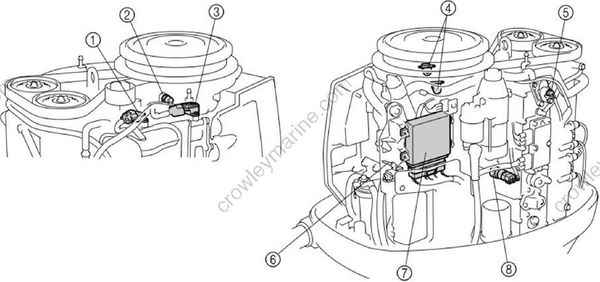
S63P1230
(1)Intake air pressure sensor
(2) Engine temperature sensor
(3)Throttle position sensor
(4)Pulser coil
(5)Thermoswitch
(6)Intake air temperature sensor
(7)ECM
(8)Oil pressure sensor
ECM
This engine is controlled by the ECM to obtain precise combustion under various operating conditions for high power output, low fuel consumption, and low emissions.
The ECM controls the ignition timing, the fuel injection timing, and the fuel injection volume and ensures that optimum ignition timing and an optimum air and fuel ratio can be achieved under all operating conditions such as starting the engine, normal operation, and quick acceleration.
The self-diagnostic function is incorporated into the ECM, and can quickly detect a malfunction when a personal computer is used with the optional software installed. (Refer to the “Yamaha Diagnostic System Instruction Manual”.)
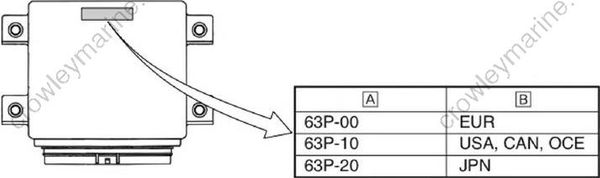
S63P1240
[A]ECM identification
[B] Destination 1-17
Fail-safe control
If the electrical components malfunction, the ECM controls the ignition and fuel injection as shown in the table.
| Malfunctioning item | Details | Ignition control | Fuel control |
|---|---|---|---|
| Pulser coil | No signal received during four consecutive crankshaft rotations | Fixed to BTDC 10° | Fixed to BTDC 10° |
| Throttle position sensor | Output voltage is 0.3 V or lower or 4.7 V or higher | Controlled accord ing to the basic injection map | Controlled by Intake air pressure and engine speed |
| Intake air pressure sensor | Output voltage is 0.2 V or lower or 4.5 V or higher | Normal control | Fuel injection volume is controlled by the throttle position sensor |
| Engine temperature sensor | Output voltage is 0.18 V or lower or 4.93 V or higher | Normal control | Normal control |
| Intake air temperature sensor | Output voltage is 0.10 V or lower or 4.61 V or higher | Normal control | Normal control |
| Neutral switch | Switch is off when starting the outboard motor | Normal control | Normal control |
| Thermoswitch | The switch is on when the engine temperature is 40 °C (104 °F) or lower or the switch is off when the engine temperature is 130 °C (266 °F) or higher. | Normal control | Normal control |
| Shift cut switch | Output voltage is 4.50 V or higher, the switch is on when the outboard motor is started, or both the shift cut switch and neutral switch are on for 5 seconds | Normal control | Normal control |
| Oil pressure sensor | Output voltage is 0.3 V or lower or 4.8 V or higher | Normal control | Normal control |
During fail-safe control, the engine idle speed increases to 900 r/min except if the neutral switch is off when the outboard motor is started..
Warning control
This outboard motor is equipped with warning control functions to avoid serious engine damage. The engine speed is limited to approximately 2,000 r/min if the engine overheats, if the oil pressure is low, or if a dual engine system (DES) is operated.
When a switch turns on, the engine speed is controlled as shown in the table.
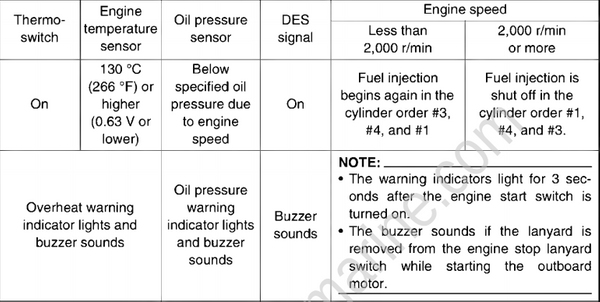
Fuel injection is shut off in the cylinder order #1, #4, and #3 at 2.5-second intervals when the engine is running at 2,000 r/min or more.
Fuel injection to the #2 cylinder is not shut off.
When the throttle-opening angle is 30 degrees or less, fuel injection to the #3 cylinder will begin again.
When the engine speed decreases to less than 2,000 r/min, fuel injection will begin again in the cylinder order #3, #4, and #1 at 0.2-second intervals.
The warning control mode deactivates when the engine speed is less than 1,600 r/min or the throttle-opening angle is less than 7 degrees..
Shift cut control
This outboard motor is equipped with a shift cut control system for easier shifting.
This device misfires and retards the ignition of some cylinders to fluctuate the engine speed instantly when the engine is running from 400 to 2,000 r/min. This allows smooth engagement and/or disengagement of the dog clutch.
When shifting, the ignition is shut off as shown in the table.
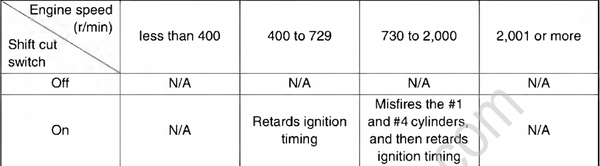
N/A: No misfire control
Over-revolution control
This outboard motor is equipped with an over-revolution control system to protect the engine.
If the engine speed exceeds 6,200 r/min, the fuel injection is shut off as shown in the table below.
| Engine speed (r/min) | Injected cylinder | Note |
|---|---|---|
| 6,199 or less | #1, #2, #3, and #4 | Normal operation |
| 6,200 to 6,300 | #2 and #3 | Over-revolution control mode |
| 6,301 to 6,550 | #2 | Over-revolution control mode |
| 6,551 or more | None | Over-revolution control mode |
Fuel pump control
The electric fuel pump operates for 3 seconds after the engine start switch is turned on and continues to operate while the engine is running.
The electric fuel pump stops 1 second after the engine is stopped.
After the engine start switch is turned on, all of the fuel injectors are driven to prevent them from sticking before the electric fuel pump is driven..