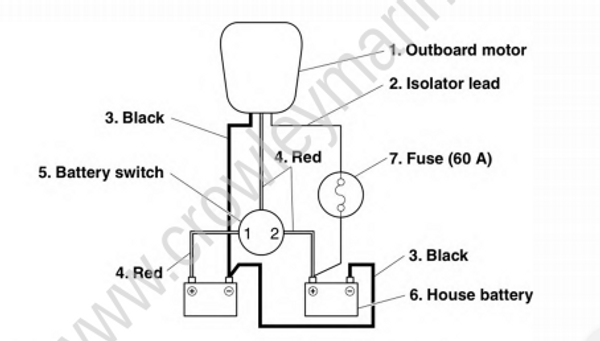
Battery installation
• Make sure to connect the battery properly and select the proper cable sizes. Otherwise, a fire could result.
• If optional isolator lead is installed and connected to a house battery, overcurrent protection in compliance with ABYC (E-11) or equivalent must be provided.
Do not reverse the battery connections. Otherwise, the charging system could be damaged.
Battery wiring without house battery
When using a dual battery installation, a negative battery cable must be installed between both engine batteries. This cable must be sized equivalent to the engine battery cables or larger AWG cable size in accordance with ABYC specifications.
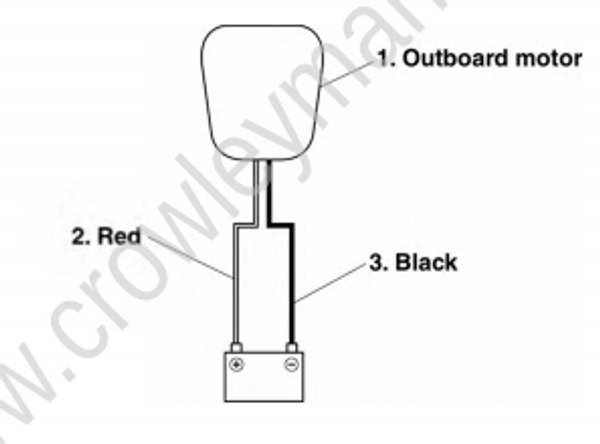
- Outboard motor
- Red
- Black
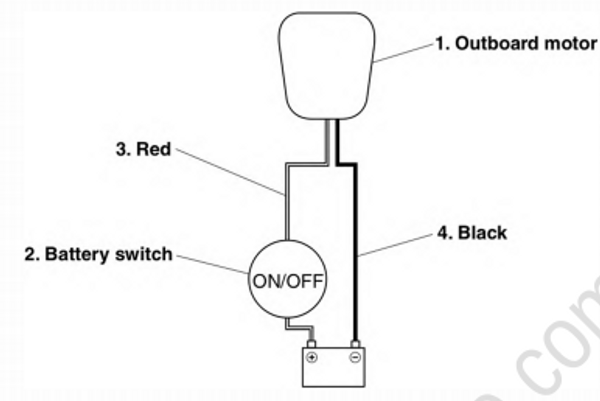
- Outboard motor
- Battery switch
- Red
- Black
Battery wiring with house battery
• When only one battery is used for one engine, connect the positive battery cable and isolator lead to the positive battery terminal. If the isolator lead is left unconnected, accidental contact of the isolator lead with the negative terminal of the battery can cause a short circuit, which may result in a fire.
• This cable must be sized equivalent to the engine battery cables or larger, such as larger AWG cables in accordance with ABYC specifications.
• Battery switches must be capable of meeting intermittent and continuous current ratings for engines and accessories.
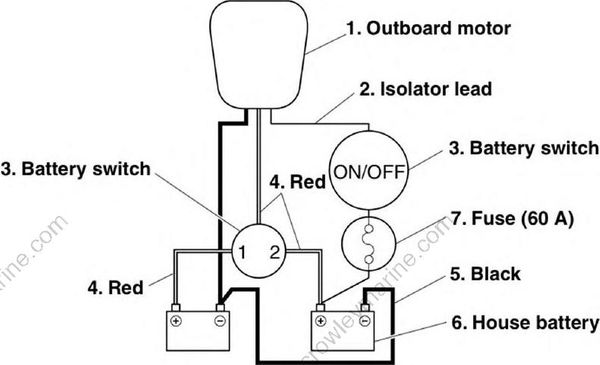
- Outboard motor
- Isolator lead
- Battery switch
- Red
- Black
- House battery
- Fuse (60 A)
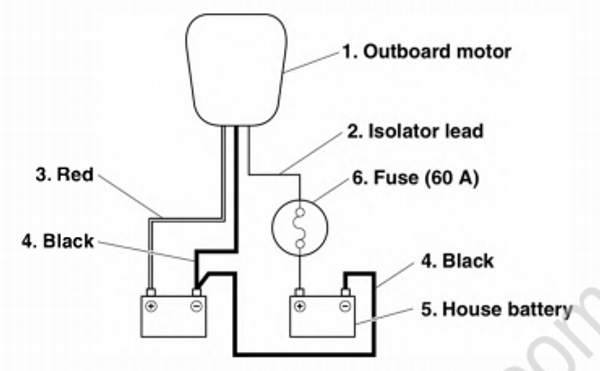
- Outboard motor
- Isolator lead
- Red
- Black
- House battery
- Fuse (60 A)