

REMOVING/INSTALLING THE HIGH-PRESSURE FUEL LINE
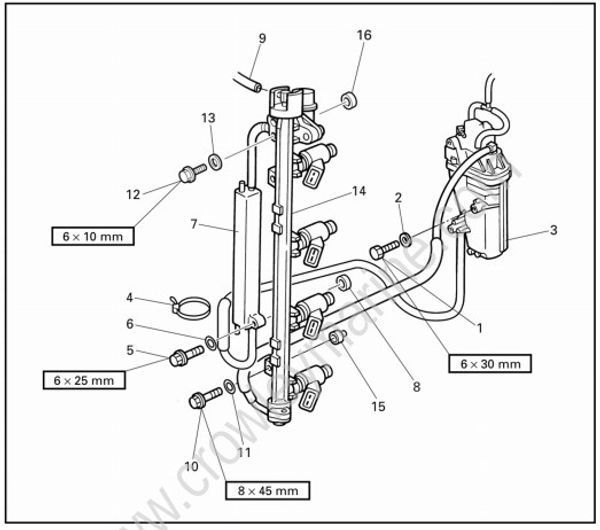
| Order | Job/Part | Q’ty | Remarks |
|---|---|---|---|
| Intake assembly | Refer to "INTAKE ASSEMBLY" on page 4-3. | ||
| 1 | Bolt | 3 | |
| 2 | Washer | 3 | |
| 3 | Vapor separator | 1 | |
| 4 | Plastic locking tie | 2 | Not reusable |
| 5 | Bolt | 2 | |
| 6 | Washer | 2 | |
| 7 | Fuel cooler | 1 | |
| 8 | Collar | 2 | |
| Continued on next page |
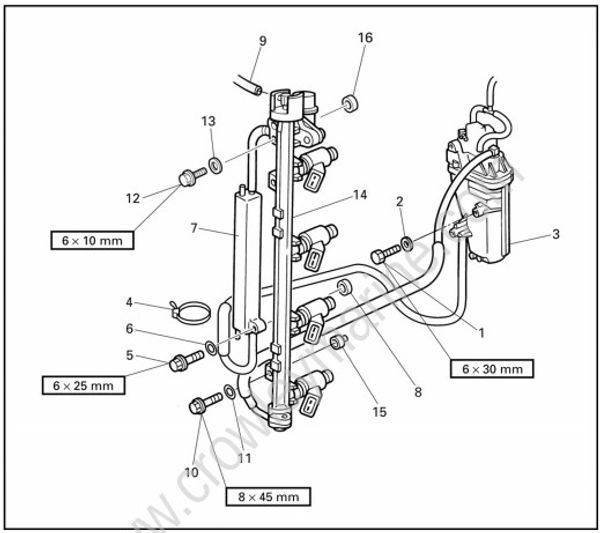
| Order | Job/Part | Q’ty | Remarks |
|---|---|---|---|
| 9 | Hose | 1 | (intake manifold—to-pressure regulator) |
| 10 | Bolt | 2 | |
| 11 | Washer | 2 | |
| 12 | Bolt | 1 | |
| 13 | Washer | 1 | |
| 14 | Fuel rail | 1 | |
| 15 | Collar | 2 | |
| 16 | Collar | 1 | |
| For installation, reverse the removal procedure. |
REDUCING THE FUEL PRESSURE (HIGH-PRESSURE FUEL LINE)
WARNING
Always reduce the fuel pressure in the high-pressure fuel line before servicing the line or the vapor separator. If the fuel pressure is not released, pressurized fuel may spray out.
- Reduce:
- Fuel pressure (high-pressure fuel line)
Reducing steps
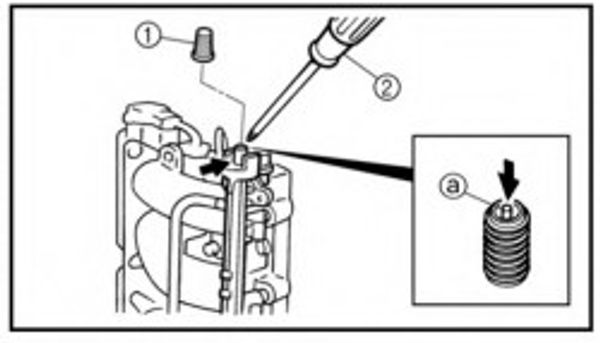
(1) Remove the cap (1)
(2) Cover the pressure check valve (a) of the fuel rail with a rag, and then press in the valve using a thin screwdriver (2) to release the fuel pressure.
WARNING
Always reduce the fuel pressure in the high-pressure fuel line before servicing the line or the vapor separator. If the fuel pressure is not released, pressurized fuel may spray out.
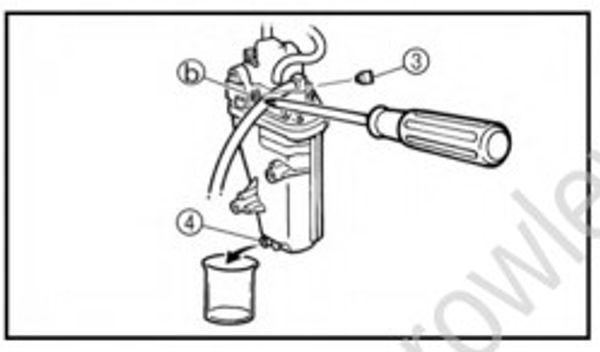
(3) Remove the cap (3), and then press in the valve (b) using a thin screwdriver (2).
(4) Place a container under the vapor separator, and then drain the fuel from the separator by removing the drain screw (4).
CHECKING THE PRESSURE REGULATOR
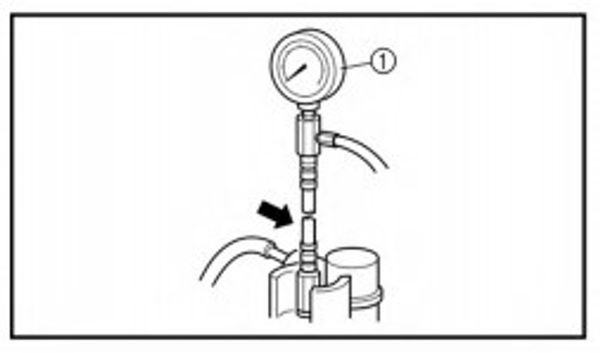
Check:
- Pressure regulator
Faulty → a Replace the pressure regulator.
Checking steps
(1) Install the fuel pressure gauge onto the pressure check valve.
Fuel pressure gauge.................(1) YB-06766 / 90890-06786
(2) Main switch to on.
(3) Check the fuel pressure.
Fuel pressure
Approx. 300 kPa (3.0 kg/cm2. 44.1 psi)
(4) Start the engine.
(5) Check the fuel pressure.
Fuel pressure
Approx. 250 kPa (2.5 kglcm2, 35.6 psi)
