

Operational Checks
DO NOT run the engine indoors or without adequate ventilation or permit exhaust fumes to accumulate in confined areas. Engine exhaust contains carbon monoxide which, if inhaled, can cause serious brain damage or death.
Contact with a rotating propeller is likely to result in serious injury or death. Assure the engine and prop area is clear of people and objects before starting engine or operating boat. Do not allow anyone near a propeller, even when the engine is off. Blades can be sharp and the propeller can continue to turn even after the engine is off.
DO NOT run outboard without a water supply to the outboard’s cooling system. Cooling system and/or powerhead damage could occur.
Start-In-Gear Prevention
Make certain that the starter will not operate when the outboard is in gear. The start-ingear prevention feature is required by the United States Coast Guard to help prevent personal injuries.
Start outboard and shift to FORWARD.
Turn outboard OFF while control is in FORWARD.
Try to restart the outboard. Outboard should not start.
Shift back to NEUTRAL and restart outboard.
Shift to REVERSE. Turn outboard OFF while control is in REVERSE.
Try to restart the outboard. Outboard should not start.
Remote Control Operation
Make sure that control can be easily moved into all gear and throttle settings.
Emergency Stop / Key Switch
Check emergency stop function. With outboard running at IDLE, pull safety lanyard from emergency stop switch. Outboard must stop immediately. If equipped, be sure to check emergency stop function of second station.
Digital Displays and Gauges
Complete basic set up of digital display or gauges. Configure engine and fuel tank, set fuel tank capacity etc. Refer to User’s Guide.
Tachometer Pulse Setting (SystemCheck)
Confirm accuracy of tachometer reading.
- Adjust dial on back of tachometer to required setting (the outboard should not be running).
| Outboard Model | Tachometer Setting |
|---|---|
| 15–300 HP | 6 Pulse or 12 Pole |
Engine Monitoring System
Attach emergency stop lanyard.
Turn key switch to the ON position.
Evinrude Touch-Screen Display — The touch screen system will run a start up sequence and then display the Evinrude welcome page. When the start up sequence is complete, the default digital display will appear.
ICON — The ICON system self-tests by sounding a beep. The ICON tachometer and speedometer LCD screens display SELF TEST MODE IN OPERATION. When the self test is complete, the gauges will beep a final time and then display SELF TEST COMPLETE!
I-Command — The I-Command system self-tests by displaying the Evinrude E-TEC welcome screen, followed by the default digital display
SystemCheck — The SystemCheck monitor selftests by sounding a half-second beep. SystemCheck gauges self-test by turning the indicator lights on simultaneously, then off in sequence.
Water Pump Overboard Indicator
A steady stream of water should flow from the overboard indicator.
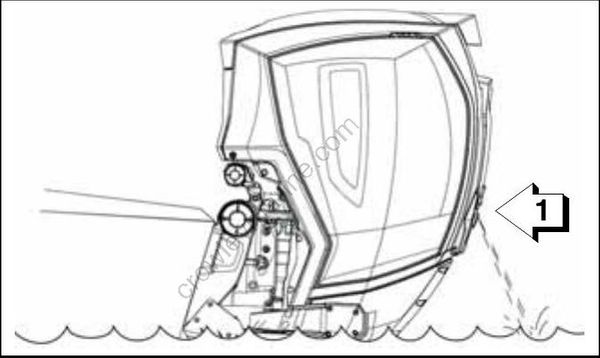
- Water pump overboard indicator
Operating Temperature
An outboard run at idle speed should achieve a temperature based on the engine’s thermostatic control. In general, the powerhead temperature should reach at least 104°F (40°C) after five minutes of idling. Check that the powerhead reaches idle temperature.
Leaks
Perform running checks of the as follows:
Start outboard.
Inspect all fuel hoses and connections.
Inspect all oil hoses and connections.
Inspect all cooling water hoses and connections.
Repair any leaks or misrouted hoses immediately.
Idle Speed
Make sure the outboard idles within the specified idle RPM range. If the outboard is run on a flushing device, the idle speed and quality may not be representative of actual in water use.
Break-In
Evinrude E-TEC outboards require no break in. When the outboard is delivered, refer the customer to the Oiling System information in the Operator’s Guide.
Propellers
Propeller Selection
Selection of the wrong propeller could reduce engine service life, affect boat performance, or cause serious damage to the powerhead.
Water testing with various propeller designs and sizes is the best method of propeller selection.
The correct propeller, under normal load conditions, will allow the engine to run near the midpoint of the RPM operating range at full throttle. Refer to SERVICE SPECIFICATIONS in the Service Manual for RPM range.
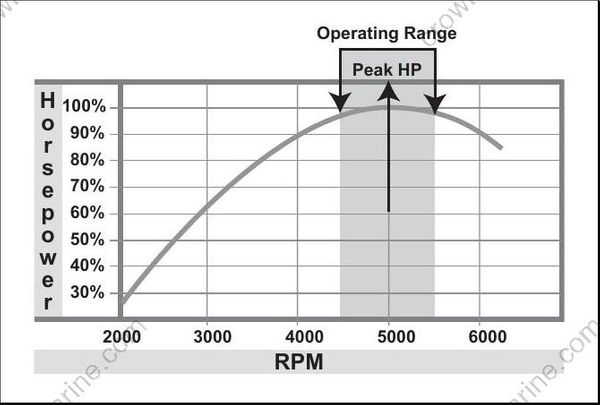
If the propeller blades have too much pitch, the engine will operate below its normal range
at full throttle. Power will be lost, and powerhead damage could occur. If the propeller blades have too little pitch, the engine will operate above its normal range and damage from overspeeding could occur.
