

RUNNING CHECKS
DO NOT run outboard without a water supply to the outboard’s cooling system. Cooling system and/or powerhead damage could occur.
DANGER DO NOT run the engine indoors or without adequate ventilation or permit exhaust fumes to accumulate in confined areas. Engine exhaust contains carbon monoxide which, if inhaled, can cause serious brain damage or death.
DANGER Contact with a rotating propeller is likely to result in serious injury or death. Assure the engine and prop area is clear of people and objects before starting engine or operating boat. Do not allow anyone near a propeller, even when the engine is off. Blades can be sharp and the propeller can continue to turn even after the engine is off.
SystemCheck Operation
Attach emergency stop lanyard.
Turn key switch to ON.
Observe the SystemCheck self-test function. Warning horn should sound for 1/2 second and all warning indicator lights should turn on at the same time, then turn off one at a time.
Fuel System
Perform running checks of the fuel system by following these steps:
• Squeeze fuel primer bulb until hard or activate electric primer. Observe all fuel hoses and connections. Repair any leaks.
• Start outboard. Inspect all hoses and connections. Repair any leaks or misrouted hoses immediately.
Emergency Stop / Key Switch
Check emergency stop function. With outboard running at IDLE, pull safety lanyard from emergency stop switch. Outboard must stop immediately.
Remote Control Operation
Start-In-Gear Prevention
Make certain that the starter will not operate when the outboard is in gear. The start-in-gear prevention feature is required by the United States Coast Guard to help prevent personal injuries.
Start outboard and shift remote control lever to FORWARD.
Turn outboard OFF while remote control is in FORWARD.
Attempt restarting the outboard. Outboard should not start.
Pull remote control lever back to NEUTRAL and restart outboard.
Shift remote control lever to REVERSE. Turn outboard OFF while remote control is in REVERSE.
Attempt restarting the outboard. Outboard should not start.
Tachometer Pulse Setting
Confirm accuracy of tachometer reading.
• Adjust dial on back of tachometer to required setting (the outboard should not be running).
| Outboard Model | Tachometer Setting |
|---|---|
| 40 – 60 Evinrude E-TEC | 6 Pulse or 12 Pole |
Water Pump Overboard Indicator
A steady stream of water should flow from the overboard indicator.
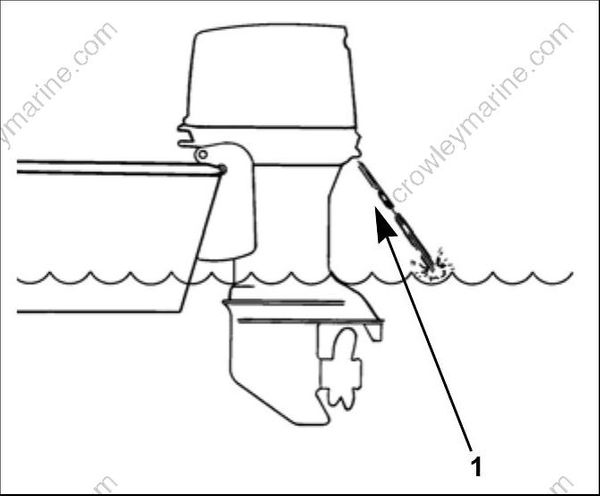
- Water pump overboard indicator
Operating Temperature
An outboard run at idle speed should achieve a temperature based on the engine’s thermostatic control. In general, the powerhead temperature should reach at least 104°F (40°C) after five minutes of idling. Check that the powerhead reaches idle temperature. Refer to TECHNICAL DATA on p. 18 for details.
Idle Speed
Break-In
When the outboard is delivered, the customer should be referred to the correct break-in procedure in the Operator’s Guide.
The Engine Management Module (EMM) on new Evinrude E-TEC models is programmed to automatically supply extra oil to the engine during the first few hours of operation above 2000 RPM.
The dealer may use the Diagnostic Software program to confirm that the break-in program has been initiated. Refer to Oil Control on p. 98.
