

Battery and Battery Connection
Check battery connections frequently. Periodically remove battery to clean and service connections.
Check battery connections frequently. Periodically remove battery to clean and service connections.
Confirm that battery meets the minimum engine requirements.
Connections must be clean and tight.
Observe all wiring connections prior to disassembly.
Disconnect battery negative (–) cable first and the battery positive (+) cable last.
Clean all terminals, battery posts, and connectors with a solution of baking soda and water. Use a wire brush or battery terminal tool to remove corrosion buildup. Rinse and clean all surfaces.
Reinstall battery and tighten all connections securely. Refer to Battery Installation on p. 27.
IMPORTANT: DO NOT secure battery cables with wing nuts.
Coat all connections with Triple-Guard grease and insulate to prevent shorts or spark arcing.
Keep battery connections clean, tight, and insulated to prevent their shorting or arcing and causing an explosion. If the battery mounting system does not cover the connections, install covers.
Fuel and Oil System
Routine replacement of filters reduces the possibility of foreign material restricting the incoming fuel or oil supplies.
Replacement filter elements are available through Evinrude/Johnson Genuine Parts.
Fuel Filter
Evinrude E-TEC 40–90 HP outboards are equipped with an in-line fuel filter. Refer to FUEL COMPONENT SERVICING on p. 166.
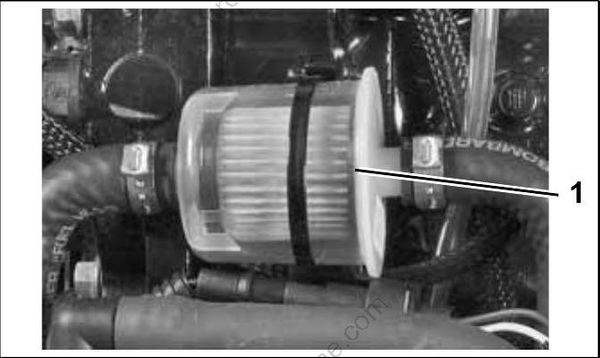
002145
- In-line fuel filter
Oil Filters and Oil Reservoir
Perform visual inspections to identify oiling system leaks. Make certain the oil tank is filled and oil supply is not contaminated.
Air Silencer
The air silencer on Evinrude outboards maximizes air flow while minimizing noise.
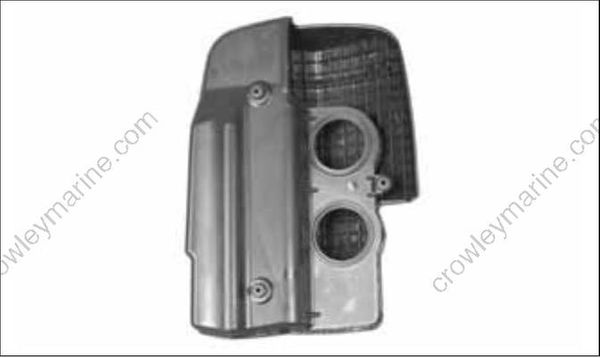
Routine cleaning of the air silencer is recommended to remove any accumulation of debris.
Hoses and Connections
Check condition of all hoses and connections in both the fuel and oil systems:
• Visually inspect all components.
• Observe all clamps, hoses, and connections while outboard is running.
• Replace all damaged components.
• Repair all leaks.
Failure to check for fuel leakage could allow a leak to go undetected, resulting in fire or explosion.
