

Operation of Power Tilt
The power tilt system has an electric motor built in the system that drives the hydraulic pump to feed pressurized oil into the tilt cylinder.
The power trim switch located on the tiller handle or remote control box is used to tilt-up or down the outboard motor.
The switch is also used for trim operation of the outboard motor during driving at low speed.
Operations of Hydraulic Circuit
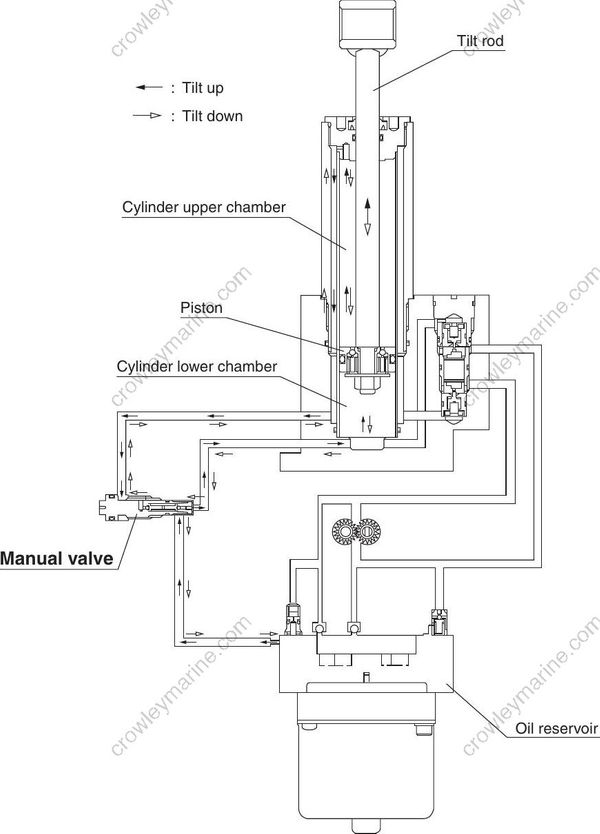
Manual Tilt Operation
Turning the manual operation valve counterclockwise 2 or 3 times opens the manual operation circuit. The outboard motor can be tilted up or down easily by hand. When the manual circuit is closed completely by turning the manual valve clockwise before the outboard motor reaches completely tilted up or down position, the outboard motor holds the position at the time.
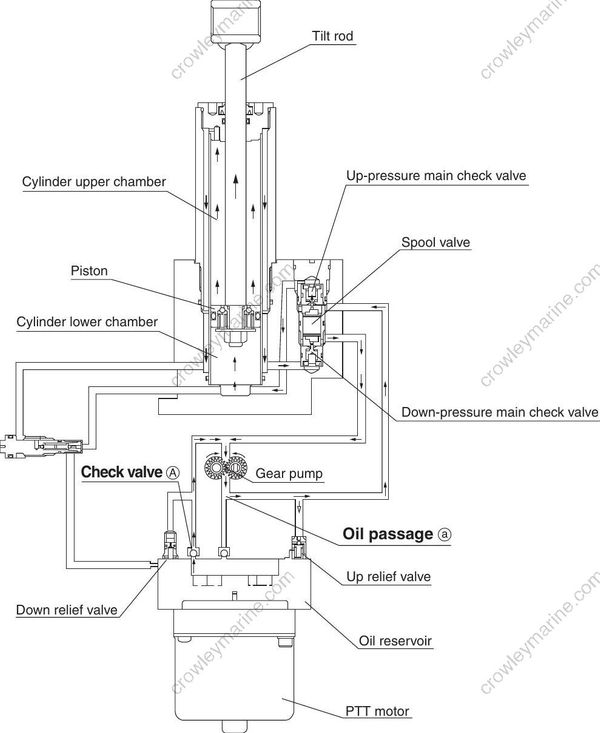
Tilt up Operation
Pressing "UP" side of PTT switch causes the PTT motor (gear of gear pump) to rotate clockwise. Check valve A opens to cause oil to flow from reservoir toward gear pump and spool valve. This oil flow shifts spool valve downward to open down-pressure main check valve. Oil in the cylinder upper chamber is returned to gear pump, hydraulic pressure of oil passage a is increased to open up-pressure main check valve, and the oil flows into cylinder lower chamber. As a result of the above operations, piston rod is pushed up to tilt up the outboard motor. The oil in the cylinder upper chamber returns to gear pump through down pressure main check valve.
Because of difference of capacity difference between cylinder upper chamber and lower chamber (piston rod at upper chamber side), oil flows into the pump through check valve A to compensate for the lack of the oil. When the motor stops, down/up pressure main check valve closes, and spool valve moves to the center. As a result, piston rod is held at a position at the time.
When tilt rod fully extends, up relief valve opens to prevent increase of hydraulic pressure of cylinder lower chamber by
relieving the pressure to protect PTT unit.
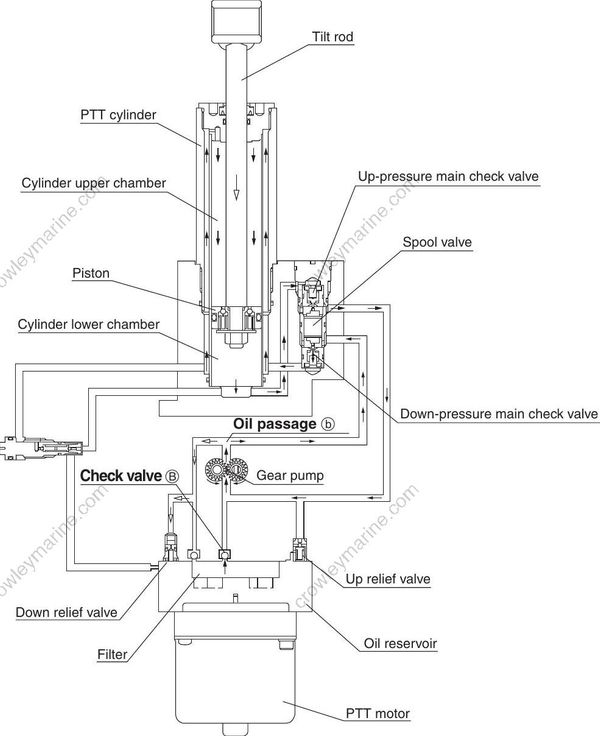
Tilt down/Trim in
Pressing "DOWN" side of PTT switch causes the PTT motor (gear pump) to rotate counterclockwise. Check valve B opens to cause oil to flow from reservoir toward gear pump and spool valve. This oil flow shifts spool valve upward to open up-pressure main check valve. Oil in the cylinder lower chamber is returned to gear pump, hydraulic pressure of oil passage b is increased to open down-pressure main check valve, and the oil flows into cylinder upper chamber. As a result of the above operations, piston rod is pushed down to tilt down the outboard motor. The oil in the cylinder lower chamber returns to gear pump through up-pressure main check valve. Because of difference of capacity difference between cylinder upper chamber and lower chamber, oil of amount exceeding upper chamber requirement returns to gear pump.
When piston rod is drawn-in completely, all of oil discharged from the pump returns from down relief valve to the reservoir.
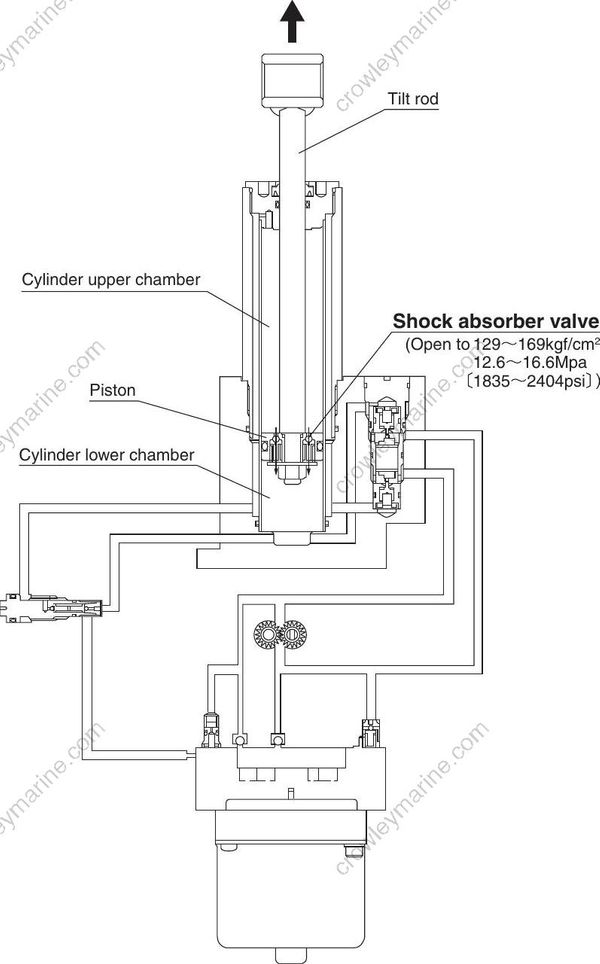
Shock Absorber Valve
The PTT unit is provided with a shock absorber that protects the drive unit from an impact in case it hits underwater obstacle during cruising.
In case drive unit hits an underwater obstacle, the hydraulic pressure in the cylinder upper chamber is increased suddenly. The high pressure opens shock valve of piston.
When shock valve opens, oil in the cylinder upper chamber flows into the lower cylinder chamber to extend tilt rod upward to absorb the shock.
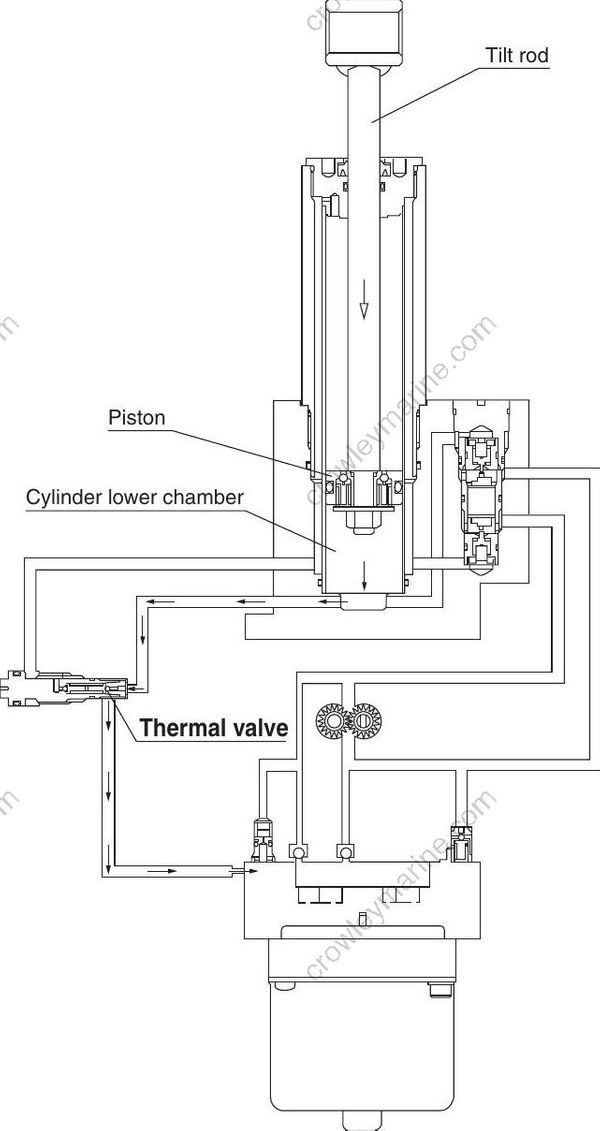
Thermal Valve
Thermal valve protects drive unit from excessive force that attempts to push down tilt rod when the outboard motor is at full tilt up position.
The piston rod to which excessive force is applied is pressed into the cylinder, resulting in increasing hydraulic pressure in the lower cylinder chamber over a rated value.
The increased hydraulic pressure reaches the thermal valve, resulting in opening the valve to dissipate itself.
