

EMM LED INDICATORS
The EMM LED indicators provide a quick reference to the status of several outboard systems. Checking the LEDs FI RST when diagnosing an engine problem can save a lot of time.
For detailed code information, refer to the EMM Service Code Chart at the back of this manual.
IMPORTANT: LED 1 is to ward the top of the outboard (Closest to EMM J1-B connector).
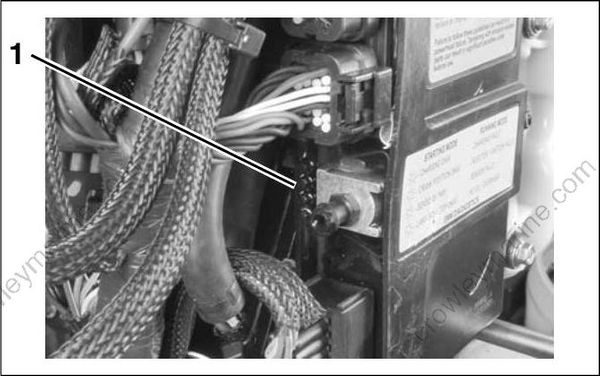
- LED indicators (Cooling hose removed for clarity)
Key ON
IMPORTANT: Diagnostic communications on non-running rope start models requires that power is supplied to the EMM. Refer to Communication
on p. 86.
When the EMM is ON (engine not running), the following LEDs should light:
LED 3 – Sensor Circuits working.
LED 4 – Stop Circuit not g rounded–okay to start. FLASHING LIGHT indicates severe overheat or no oil.
Starting
Starting mode occurs from the time t he flywheel begins to turn until the outboard is running for 2 seconds. During starting, all four LEDs should
light and then go off in sequence.
LED 1 – CHARGING OKAY – Stator signal 30 V or higher.
LED 2 – CRANK POSITION OKAY – input from CPS, EMM powered ON. For NO LIGHT, check for:
- Code 16 – CPS, intermittent loss of sync
LED 3 – SENSORS OKAY (5 V). For NO LIGHT, check for:
Code 12 – TPS circuit fault
Code 13 – TPS below expected range
Code 14 – TPS above expected range
Code 19 – In Gear
Code 23 – EMM temp. sensor circuit fault
Code 24 – EMM temp. below expected range
Code 41 – temp. sensor circuit fault
Code 42 – temp. below expected range
Code 47 – AT sensor circuit fault
Code 48 – AT sensor below expected range
Code 49 – AT sensor above expected range
Code 58 – Operating temperature not reached
Code 78 – Sensor supply voltage fault
LED 4 – LANYARD/STOP OKAY. For NO LIGHT, check for:
- Grounded stop circuit.
For FLASHING LIGHT, check for:
Code 29 – EMM temp. OVER range (flashing)
Code 31 – Engine temp. OVER range (flashing)
Code 33 – Excessive no oil condition (flashing)
Running
When the outboard is running, all of the LEDs should be off. If a light is on, check for:
LED 1 – CHARGING FAULT:
Code 17 – system voltage (55 V) below range
Code 18 – system voltage (55 V) above range
Code 26 – low battery (12 V) voltage
Code 27 – high battery (12 V) voltage
LED 2 – INJECTOR/IGNITION FAULT:
Code 51 – cylinder no. 1 injector circuit open
Code 52 – cylinder no. 2 injector circuit open
Code 61 – cylinder no. 1 injector circuit short
Code 62 – cylinder no. 2 injector circuit short
Code 81 – no. 1 ignition primary circuit open
Code 82 – no. 2 ignition primary circuit open
Code 90 – Water injection solenoid short
Code 91 – fuel pump circuit open
Code 93 – Water injection solenoid open
Code 94 – fuel pump circuit short
Code 101 – No. 1 ignition timing circuit shorted
Code 102 – No. 2 ignition timing circuit shorted
LED 3 – Sensor circuits (5 V), “SENSOR FAULT.” For LIGHT ON, check for possible fault codes:
Code 12 – TPS circuit fault
Code 13 – TPS below expected range
Code 14 – TPS above expected range
Code 16 – CPS, intermittent loss of sync
Code 23 – EMM temp. sensor circuit fault
Code 24 – EMM temp. below expected range
Code 41 – PORT temp. sensor circuit fault
Code 42 – PORT temp. below expected range
Code 47 – AT sensor circuit fault
Code 48 – AT sensor below expected range
Code 49 – AT sensor above expected range
Code 58 – operating temp. not reached
Code 78 – Sensor supply voltage fault
LED 4 – Engine overheat, EMM temperature or sensor, oil injection pump or sensor, “NO OIL / OVERHEAT.” For LIGHT ON, check for possible
fault codes:
Code 25 – EMM temp. above expected range
Code 29 – EMM temp. OVER range (flashing)
Code 31 – engine temp. OVER range (flashing)
Code 33 – excessive NO OIL faults (flashing)
Code 34 – oil injection pump circuit open
Code 43 – engine overheat
Code 117 – Critical NO OIL detected
