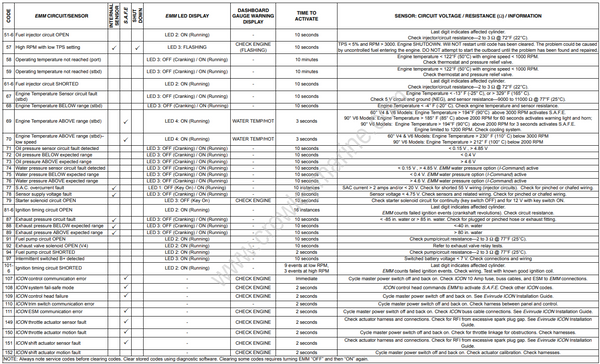
OUTBOARD WILL NOT START
| OBSERVATION | POSSIBLE CAUSE | PROCEDURE |
|---|---|---|
| Outboard does not turn over | Battery switch not ON | Check battery switch operation |
| Outboard does not turn over | Discharged battery | Check battery, recharge or replace |
| Outboard does not turn over | Battery cables and connections | Clean and tighten connections. Check for voltage drop in starter circuit. |
| Outboard does not turn over | Faulty connection or ground, damaged electrical harness | Check all grounds, connections and wiring |
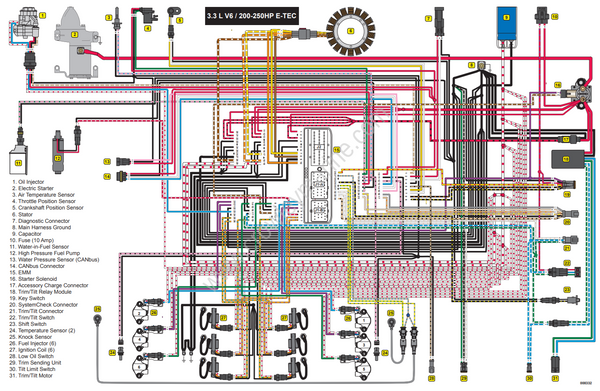
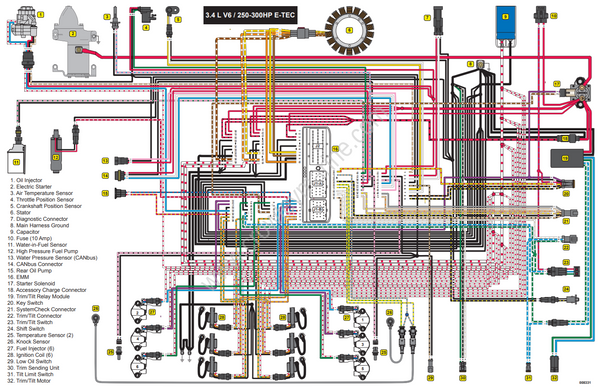
| Outboard does not turn over | Fuse (10 A) | Check wiring, then replace faulty fuse |
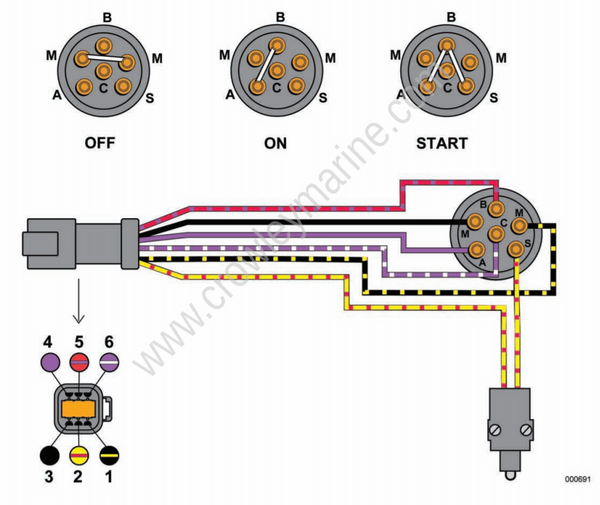
| Outboard does not turn over | Wiring harness | Check for 12 V at terminal “B” of key switch |
| Outboard does not turn over | Key switch | Check key switch operation |
| Outboard does not turn over | Starter solenoid | Check wiring and test solenoid |
| Outboard does not turn over | Starter or bendix/drive gears | Check starter, inspect bendix/drive gears |
| Outboard does not turn over | Seized powerhead or gearcase | Check and repair as needed |
| Outboard turns slowly | Discharged battery | Check battery, recharge or replace |
| Outboard turns slowly | Battery cables and connections | Clean and tighten connections. Check voltage drop in starter circuit. |
| Outboard turns slowly | Powerhead hydro-locked | Check cylinders for water |
| Outboard turns slowly | Partially seized powerhead or gearcase | Check and repair as needed |
| Outboard turns slowly | Starter or bendix/drive gears | Check starter, inspect bendix/drive gears |
OUTBOARD WILL NOT START
| OBSERVATION | POSSIBLE CAUSE | PROCEDURE |
|---|---|---|
| Outboard turns over | Stop circuit grounded | Check wiring and emergency stop switch. Check the safety lanyard is installed and stop circuit is not grounded. |
| Outboard turns over | No Fue | Check for fuel in fuel tank |
| Outboard turns over | Water in fuel | Check fuel filter, sample fuel from fuel return manifold |
| Outboard turns over | Contaminated or poor fuel quality | Check or replace fuel supply |
| Outboard turns over | Fuel supply restricted | Check primer, anti-siphon valve, and fuel pick-up. Use primer to fill vapor separator with fuel. |
| Outboard turns over | Air in fuel system | Check for air in fuel supply manifold, refer to FUEL SYSTEM (vapor separator venting and fuel supply) |
| Outboard turns over | Low or no fuel pressure to injectors | Check fuel manifold pressure, refer to FUEL SYSTEM |
| Outboard turns over | Incorrect, fouled, or worn spark plugs | Replace spark plugs |
| Outboard turns over | Fuel injectors not working | Check voltage at injectors |
| Outboard turns over | Excessive fuel or oil, engine flooded | Check for leaking injectors, leaking fuel or oil lift pump, or leaking vapor separator vent, refer to SYSTEM ANALYSIS |
| Outboard turns over | Low or no 55 V alternator output | Check voltage on 55 V circuit, refer to SYSTEM ANALYSIS and ELECTRICAL AND IGNITION |
| Outboard turns over | Capacitor or 55 V circuit wiring | Check capacitor and 55 V circuits, refer to SYSTEM ANALYSIS and ELECTRICAL AND IGNITION |
| Outboard turns over | Ignition | Check ignition, refer to SYSTEM ANALYSIS and ELECTRICAL AND IGNITION |
| Outboard turns over | CPS input to EMM, no sync | Check RPM reading while cranking |
| Outboard turns over | No ignition system primary voltage output from EMM to ignition coils | Check cranking RPM (300 minimum), refer to SYSTEM ANALYSIS |
| Outboard turns over | Low or no compression | Check compression |
| Outboard turns over | Water in engine | Check condition of spark plugs and cylinders |
| Outboard turns over | Internal powerhead damage | Check and repair as needed |
| Outboard turns over | Leaking cylinder/crankcase, intake manifold, or reed valves | Check and repair as needed |
| Outboard turns over | EMM program, timing, or operation | Check EMM program and timing; check injector information (by location and serial number) |
OUTBOARD HARD TO START
| OBSERVATION | POSSIBLE CAUSE | PROCEDURE |
|---|---|---|
| Outboard eventually starts, may or may not run properly once started. | Weak battery | Check battery, recharge or replace |
| Outboard eventually starts, may or may not run properly once started. | Battery cables and connections | Clean and tighten connections, check voltage drop on high amperage circuit. |
| Outboard eventually starts, may or may not run properly once started. | Starter or bendix/drive gears | Check starter, inspect bendix/drive gears |
| Outboard eventually starts, may or may not run properly once started. | Water in fuel system | Check water separator/fuel filter, sample fuel from fuel return manifold test port |
| Outboard eventually starts, may or may not run properly once started. | Contaminated or poor fuel quality | Check or replace fuel supply |
| Outboard eventually starts, may or may not run properly once started. | Air in fuel system | Check for air in fuel supply manifold, refer to FUEL SYSTEM (vapor separator venting and fuel supply) |
| Outboard eventually starts, may or may not run properly once started. | Incorrect, fouled, or worn spark plugs | Replace spark plugs |
| Outboard eventually starts, may or may not run properly once started. | Low fuel pressure | Check pressure, refer to FUEL SYSTEM |
| Outboard eventually starts, may or may not run properly once started. | Fuel supply restricted | Check primer bulb, anti-siphon valve, and fuel pick-up, check for fuel system air leaks. |
| Outboard eventually starts, may or may not run properly once started. | Low or no alternator output (55 V) | Check voltage on 55 V circuit, refer to SYSTEM ANALYSIS and ELECTRICAL AND IGNITION |
| Outboard eventually starts, may or may not run properly once started. | Capacitor or 55 V circuit wiring | Check capacitor and 55 V circuit (white/red), refer to SYSTEM ANALYSIS and ELECTRICAL AND IGNITION |
| Outboard eventually starts, may or may not run properly once started. | Restricted or leaking fuel injector(s) | Check injectors, refer to FUEL SYSTEM |
| Outboard eventually starts, may or may not run properly once started. | Weak or erratic ignition operation | Check ignition, refer to SYSTEM ANALYSIS and ELECTRICAL AND IGNITION |
| Outboard eventually starts, may or may not run properly once started. | Crankshaft Position Sensor (CPS) | Check CPS air gap and EMM LED indicators |
| Outboard eventually starts, may or may not run properly once started. | Excessive fuel or oil, engine flooding | Check for leaking injectors, leaking fuel or oil lift pump, or leaking vapor separator vent. Refer to SYSTEM ANALYSIS. |
| Outboard eventually starts, may or may not run properly once started. | EMM program, timing, or operation | Check EMM program and timing; check injector coefficients; and monitor injector circuits and ignition primary outputs |
| Outboard eventually starts, may or may not run properly once started. | Internal powerhead damage | Check and repair as needed |
| Outboard eventually starts, may or may not run properly once started. | Low compression | Check compression |
| Outboard eventually starts, may or may not run properly once started. | Leaking cylinder/crankcase intake manifold, or reed valves | Check and repair as needed |
OUTBOARD WILL NOT SHUT OFF
| OBSERVATION | POSSIBLE CAUSE | PROCEDURE |
|---|---|---|
| Outboard starts and runs, normal performance while running | Key switch or wire harness ground | Check key switch and ground to key switch, refer to SYSTEM ANALYSIS and ELECTRICAL AND IGNITION |
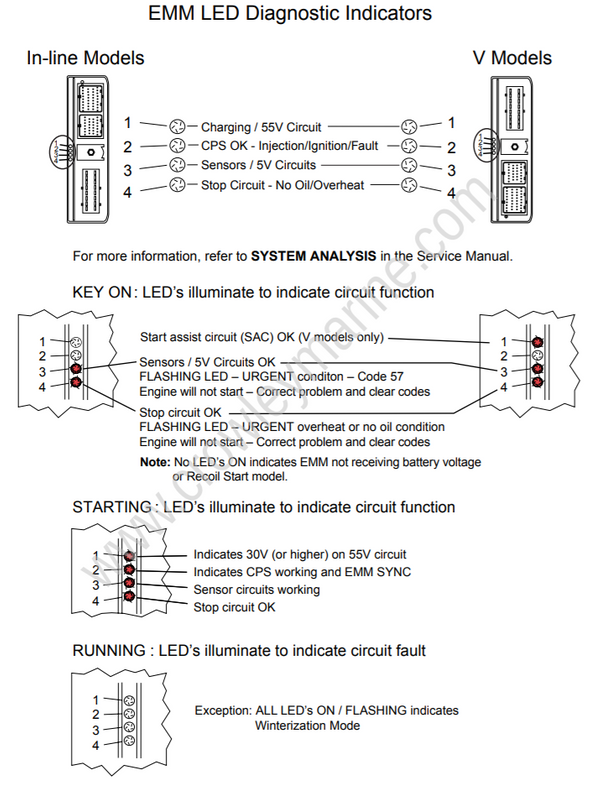
| Outboard starts and runs, normal performance while running | Stop circuit wiring | Check EMM LED indicators. Check wire harness (black/yellow) and key/stop switch(s). |
| Outboard starts and runs, normal performance while running | EMM failure | Check EMM LED indicators and eliminate stop circuit as possible cause. Stop wire (black/yellow) has 4.0 VDC from EMM with key on or outboard running, |
OUTBOARD STARTS AND STALLS
| OBSERVATION | POSSIBLE CAUSE | PROCEDURE |
|---|---|---|
| Outboard may not run for more than a few seconds | Faulty wiring, connections, or grounds | Check all grounds, connections, and wiring |
| Outboard may not run for more than a few seconds | Incorrect, fouled, or worn spark plugs | Replace spark plugs |
| Outboard may not run for more than a few seconds | Low or no alternator output (55 V) | Check voltage on 55 V circuits, refer to SYSTEM ANALYSIS and ELECTRICAL AND IGNITION |
| Outboard may not run for more than a few seconds | Capacitor or 55 V circuit wiring | Check capacitor and 55 V circuit, refer to SYSTEM ANALYSIS and ELECTRICAL AND IGNITION |
| Outboard may not run for more than a few seconds | Contaminated or poor fuel quality | Check or replace fuel supply |
| Outboard may not run for more than a few seconds | Low fuel pressure | Check pressure, refer to FUEL SYSTEM |
| Outboard may not run for more than a few seconds | Air in fuel system | Check for air in fuel supply manifold, refer to FUEL SYSTEM (vapor separator venting and fuel supply) |
| Outboard may not run for more than a few seconds | Fuel supply restricted | Check primer bulb, anti-siphon valve, and fuel pick-up, check for fuel system air leaks |
| Outboard may not run for more than a few seconds | Injector electrical circuit or control function | Check voltage at injectors, refer to SYSTEM ANALYSIS |
| Outboard may not run for more than a few seconds | Restricted or leaking fuel injector(s) | Check injectors, refer to FUEL SYSTEM |
| Outboard may not run for more than a few seconds | EMM program, timing, or operation | Check EMM program and timing; check injector coefficients; and monitor injector control wires and ignition primary outputs |
| Outboard may not run for more than a few seconds | Weak or erratic ignition output | Check ignition, refer to SYSTEM ANALYSIS and ELECTRICAL AND IGNITION |
| Outboard may not run for more than a few seconds | Internal powerhead damage | Check and repair as needed |
OUTBOARD STARTS, LOW MAXIMUM RPM
| OBSERVATION | POSSIBLE CAUSE | PROCEDURE |
|---|---|---|
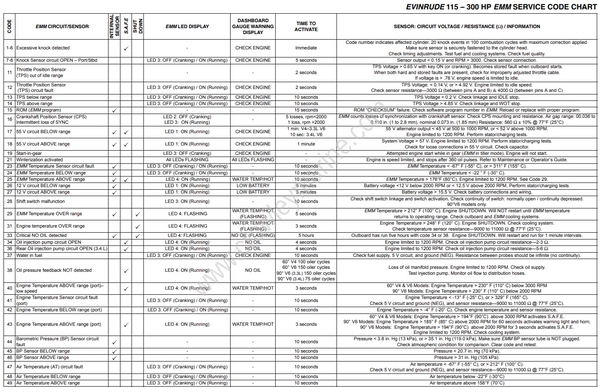
| SystemCheck light | Outboard is in S.A.F.E. | Access EMM service codes and check SystemCheck warning |
| Setup or rigging change | Incorrect propeller | Refer to specifications, check recommended WOT RPM; water test and install correct pitch propeller |
| Setup or rigging change | Incorrect outboard mounting height | Refer to installation guidelines |
| Performance of outboard at lower speeds appears normal | Throttle plate opening | Check throttle plate and WOT opening |
| Performance of outboard at lower speeds appears normal | Incorrect, fouled, or worn spark plugs | Replace spark plugs |
| Performance of outboard at lower speeds appears normal | Contaminated or poor quality fuel | Check or replace fuel supply |
| Performance of outboard at lower speeds appears normal | Fuel supply restricted | Check primer bulb, anti-siphon valve, and fuel pick-up, check for fuel system air leaks |
| Performance of outboard at lower speeds appears normal | Low alternator output (55 V) | Check voltage on 55 V circuits, refer to SYSTEM ANALYSIS and ELECTRICAL AND IGNITION |
| Performance of outboard at lower speeds appears normal | Weak or erratic ignition operation | Check ignition, refer to SYSTEM ANALYSIS and ELECTRICAL AND IGNITION |
| Performance of outboard at lower speeds appears normal | Fuel injector electrical circuit or control function | Check voltage at injectors, refer to SYSTEM ANALYSIS |
| Performance of outboard at lower speeds appears normal | Restricted or leaking fuel injectors | Check injectors, refer to FUEL SYSTEM |
| Performance of outboard at lower speeds appears normal | Low fuel pressure | Check circulation pump operation, refer to FUEL SYSTEM |
| Performance of outboard at lower speeds appears normal | EMM programming, timing, or operation | Check EMM program and timing; check injector coefficients; and monitor injector circuits and ignition primary outputs |
| Performance of outboard at lower speeds appears normal | Restricted engine exhaust | Check and repair as needed |
EXCESSIVE SMOKING
| OBSERVATION | POSSIBLE CAUSE | PROCEDURE |
|---|---|---|
| May coincide with increase oil consumption (normal if occurs after winterization) | Contaminated or poor fuel | Check or replace fuel supply |
| May coincide with increase oil consumption (normal if occurs after winterization) | Excessive fuel or oil consumption | Check fuel system for fuel supply air leaks or leaking fuel injectors |
| May coincide with increase oil consumption (normal if occurs after winterization) | Outboard in break-in mode | Use diagnostic program to confirm |
| May coincide with increase oil consumption (normal if occurs after winterization) | Outboard mounted too low | Check installation height of outboard |
| May coincide with increase oil consumption (normal if occurs after winterization) | Vapor separator vent | Check vapor separator assembly for proper venting/float valve operation |
| May coincide with increase oil consumption (normal if occurs after winterization) | Faulty/leaking fuel injector(s) | Check injectors, refer to FUEL SYSTEM |
| May coincide with increase oil consumption (normal if occurs after winterization) | Damaged fuel lift pump | Check for internal leaks |
OUTBOARD SURGES, RUNS ROUGH
| OBSERVATION | POSSIBLE CAUSE | PROCEDURE |
|---|---|---|
| 1200 RPM and above | S.A.F.E | Access EMM fault codes |
| May be erratic or inconsistent | Incorrect, fouled, or worn spark plugs | Replace spark plugs |
| May be erratic or inconsistent | Water in fuel system | Check water separator/fuel filter, sample fuel from fuel return manifold test port |
| May be erratic or inconsistent | Contaminated or poor fuel quality | Check and replace fuel supply |
| May be erratic or inconsistent | Low or erratic fuel pressure | Check pressure, refer to FUEL SYSTEM |
| May be erratic or inconsistent | Air in fuel system | Check for air in fuel supply manifold, refer to FUEL SYSTEM (vapor separator venting and fuel supply) |
| May be erratic or inconsistent | Fuel supply restricted | Check primer bulb, anti-siphon valve, and fuel pick-up, check for fuel system air leaks |
| May be erratic or inconsistent | Restricted or leaking fuel injector(s) | Check injectors, refer to FUEL SYSTEM |
| May be erratic or inconsistent | Faulty wiring, connections, grounds or CPS air gap | Check all grounds, connections, and wiring. Check CPS air gap. |
| May be erratic or inconsistent | Low alternator output (55 V) | Check voltage on 55 V circuit, refer to SYSTEM ANALYSIS and ELECTRICAL AND IGNITION |
| May be erratic or inconsistent | EMM program, timing, or operation | Check EMM program and timing; check injector coefficients; and monitor injector circuits and ignition primary outputs |
| May be erratic or inconsistent | Weak or erratic ignition operation | Check ignition, refer to SYSTEM ANALYSIS and ELECTRICAL AND IGNITION |
| May be erratic or inconsistent | Capacitor or 55 V circuit wiring | Check capacitor and 55 V circuit (white/red), refer to SYSTEM ANALYSIS and ELECTRICAL AND IGNITION |
| May be erratic or inconsistent | Restricted engine exhaust | Check and repair as needed |
| May be erratic or inconsistent | Propping | Change propeller type or size as needed |
| Audible noise | Internal powerhead damage | Check and repair as needed |
| Audible noise | Damaged gearcase | Inspect gearcase and lubricate |
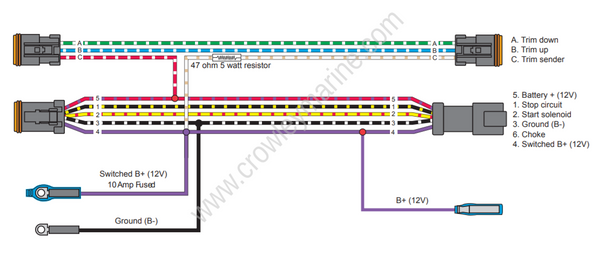
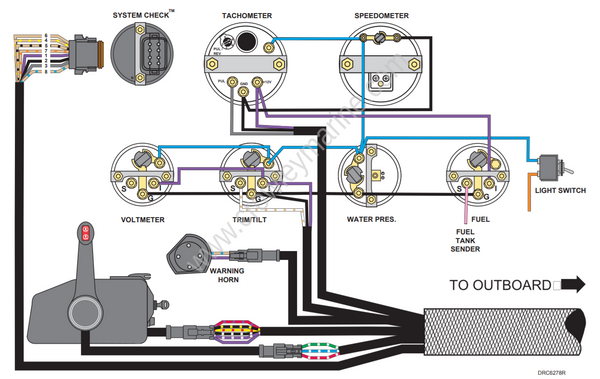
MWS Instrument Wiring Harness
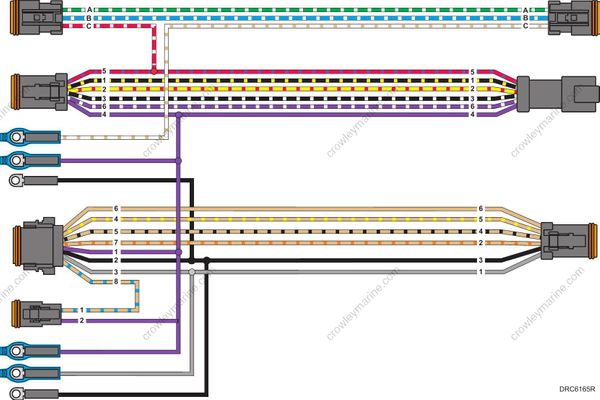
I-Command Keyswitch/TNT Wiring Harness
Lanyard Switch / Emergency Stop Circuits
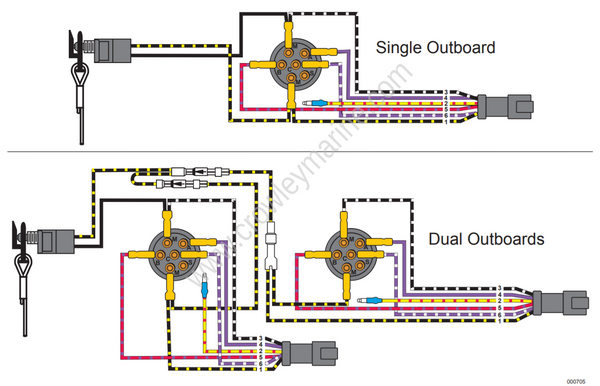
MWS Key Switch and Neutral Safety Switch
MWS DASHBOARD
Evinrude E-TEC