

INSTALLATION AND PREDELIVERY
Install the spacer over the propeller shaft splines.
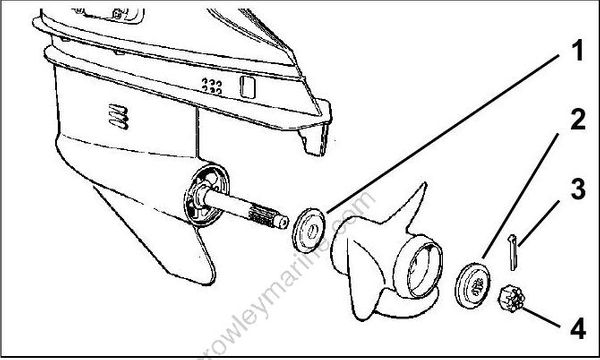
- Thrust bushing
- Spacer
- Cotter pin
- Propeller Nut
Wedge a block of wood between propeller blade and the anti-ventilation plate.
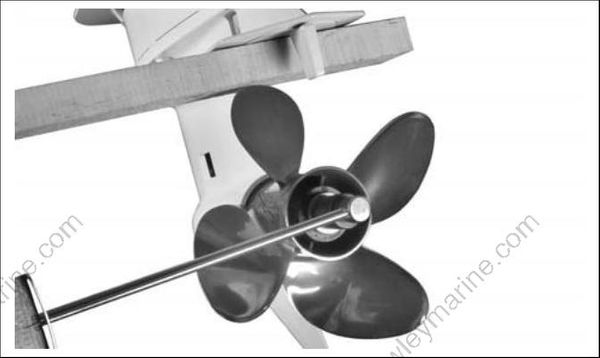
Install the propeller nut and tighten to a torque of:
- 120 to 144 in. lbs. (13.5 to 16.5 N·m)
If cotter pin holes in the nut and shaft do not align, tighten further. Do not loosen. Install new cotter pin.
IMPORTANT: After installation, make sure out board is in NEUTRAL and carefully spin propeller. Propeller must turn freely and should not spin off center. If propeller appears to wobble, check for possible bent propeller shaft.
WATER TEST AND FINAL ADJUSTMENTS
Engine Mounting Height Adjustment
Goals include:
- Engine RPM within the full throttle operating range
- Best acceleration and top speed
- No excessive ventilation while boat is coming onto plane.
Start with the engine lower on the transom. Make a test run, taking note of engine RPM, water pressure, trim level and boat speed.
Raise the engine and repeat the process until the best acceleration and boat speed are achieved.
Fuel System Vacuum
Test boat fuel system vacuum. Refer to Lift Pump Vacuum Test on p. 142. The maximum inlet fuel vacuum should not exceed 4 in. Hg. (13.5 kPa) at the inlet to the fuel lift pump under any operating conditions (IDLE to WOT).
A higher vacuum indicates an excessive restriction in the fuel supply. Repair as needed.
Trim Tab Adjustment (MRL)
Improper trim tab adjustment can cause difficult steering and loss of control.
A propeller will generate steering torque when the propeller shaft is not running parallel to the water’s surface. The trim tab is adjustable to compensate for this steering torque.
IMPORTANT: A single trim tab adjustment will relieve steering effort under only one set of speed, outboard angle and load conditions. No single adjustment can relieve steering effort under all conditions.
If the boat pulls to the left or right when its load is evenly distributed, adjust the trim tab as follows:
With the engine OFF, loosen the trim tab screw. If the boat pulled to the right, move rear of the trim tab slightly to the right. If the boat pulled to the left, move rear of the trim tab slightly to the left.
Tighten the trim tab screw to a torque of 35 to 40 ft. lbs. (47.5 to 54 N·m).
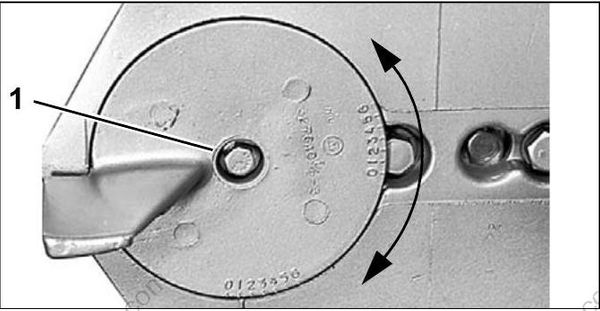
- Trim tab screw
Test the boat and, if needed, repeat the procedure until steering effort is as equal as possible.
Outboards with High Transom Heights
The trim tab may be above the surface of the water when the outboard is trimmed out. Steering effort might increase. Lower the trim setting to submerge the trim tab and to reduce steering effort.
