

SHIFT ROD ADJUSTMENT
Check the shift rod height from the shift rod hole to the surface of the gearcase using Universal Shift Rod Height Gauge, P/N 389997.
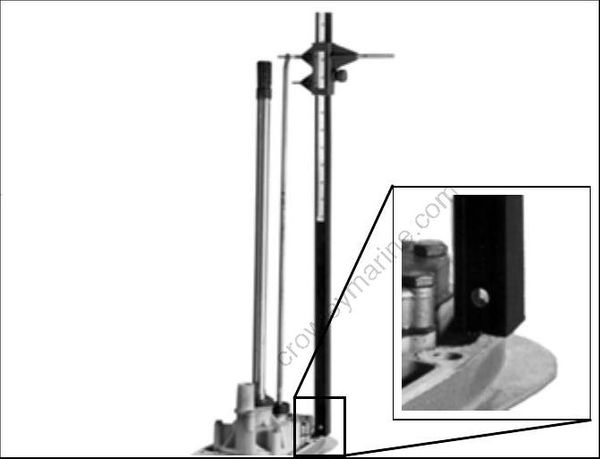
With the shift rod and detent lever in NEUTRAL, rotate the shift rod up or down as necessary for correct adjustment. Once correct height is achieved, rotate rod one half turn or less to face offset forward.
IMPORTANT: The NEUTRAL detent is a two step design. Make sure the NEUTRAL detent ball is in the center step before checking shift rod height.
Shift Rod Heights
| Model | Type | Height |
|---|---|---|
| 20 in. (L) | “S2” (V4)“O” (V6)“L” (V6) | 20 15/16 in.(20.945 in./ 532 mm)± 1/2 Half Turn |
| 25 in. (X) | “O” (V4)“M” (V6) | 25 15/16 in.(25.945 in./659 mm)± 1/2 Turn |
DISASSEMBLY
Wear safety glasses to avoid personal injury, and set compressed air pressure to less than 25 psi (172 kPa).
IMPORTANT: Clean and inspect all components during disassembly. Replace any damaged com ponents, seals, O-rings, and gaskets upon assembly.
Remove the propeller and mounting hardware.
Drain and inspect oil as described in LUBRICANT on p. 307.
Remove gearcase as described in REMOVAL AND INSTALLATION on p. 308.
Remove water pump as described in WATER PUMP on p. 311.
Pre-Disassembly Inspection
Before disassembling the gearcase, examine the following:
Gearcase Housing — Check for visible damage to skeg, strut, anti-ventilation plate, bullet, and mating surface. Check seal areas for visible signs of lubricant leakage.
Propeller Shaft — Check for bent or damaged shaft. Check for twisted splines and damaged threads.
Shift Rod — Check for misadjusted, bent, or binding rod. A misadjusted shift rod height can cause shift difficulty, loss of boat and outboard control, and gearcase damage.
