GEARCASE TYPES, 75 – 90 HP
| Outboard Model | Gearcase Type | General Comparison | Service Procedure Comparison |
|---|---|---|---|
| (L) Models with 20 in. shaft | “S” | Unique housing, shafts, gears, and bearings | Similar |
| (X) Models with 25 in. shaft | “O” | Unique housing, shafts, gears, and bearings | Similar |
PROPELLER SERVICE
Inspection
Carefully examine propeller and outboard for the following:
Damaged blades and signs of propeller cavitation (burned paint, etc.)
Spun or overheated inner hub
Worn or twisted splines and inadequate lubricant
Damaged or missing converging ring (if applicable)
Damage to outer hub area
Worn, missing, or incorrect thrust washer and spacer
Correct size and style
Check for bent or damaged propeller shaft and twisted splines.
Refer to Propeller Hardware Installation on p. 70.
When servicing the propeller, always shift the outboard to NEUTRAL, turn the key
switch OFF, and disconnect the battery positive (+) cable so the outboard cannot be started accidentally
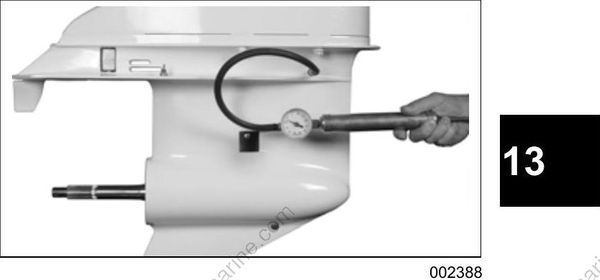
GEARCASE LEAK TEST
Drain lubricant before testing.
Install lubricant drain/fill plug and seal, thread pressure test gauge fitting and seal in lubricant level hole.
Pressurize 3 to 6 psi (21 to 42 kPa).
If pressure gauge indicates leakage, submerge the gearcase in water to determine source of leak.
If the gearcase pressure gauge does not indicate leakage, increase pressure to 16 to 18 psi (110 to 124 kPa). Check for leakage.
Make necessary repairs and repeat test.
Install vacuum test gauge. Apply 3 to 5 in. of vacuum (76 to 127 mm) Hg. with pump.
Check for leaks.
If leakage occurs, apply oil around suspected seal. If leak stops or oil is drawn in, that seal is defective.
Repeat test, gearcase must hold minimum of 15 in. vacuum (381 mm) Hg.