

Oil Recirculation System
External hoses and fittings, and intake manifold passages are used to recirculate any accumulation of oil from various locations in the powerhead. The movement of oil is controlled by check valves.
Crankcase / Main Bearing Recirculation
The movement of oil through the main bearings is controlled by internal passages, external fittings and hoses, and check valves.
Lower to upper main bearing oil flow:
- Lower main bearing cavity to internal crankcase passage to external fitting, external hoses with in-line check valve to external fitting at upper main bearing, and into upper main bearing through internal crankcase passage.
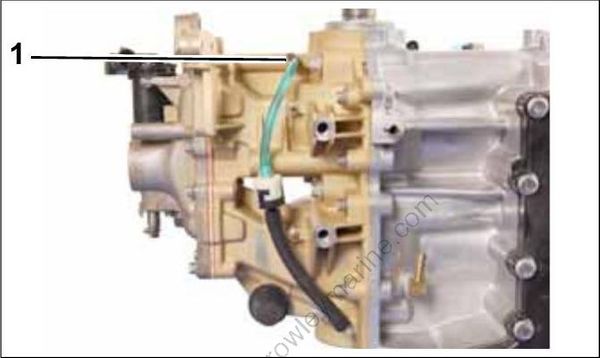
- Upper main bearing vent
Refer to the OIL RECIRCULATION DIAGRAM on p. 172.
OIL CONTROL SETTINGS
Oil Priming
The oiling system of the outboard must be primed:
- When the outboard is first installed.
- Whenever the oil supply to the oil lift pump is disconnected or disrupted.
- Whenever an oiling system component is removed or replaced.
- Whenever the outboard is transported in a horizontal position (laid down).
Refer to Oil Supply Priming on p. 51.
Oiling Rates
EMM programming controls the rate of oil injection based on engine RPM. This rate can be adjusted for the grade of oil being used, and also for power head break-in. Use Evinrude Diagnostics software to access these features.
Refer to Oil Injection Rate on p. 50.
Break-in Oiling
The EMM automatically supplies extra oil to the engine during the first two hours of operation, above 2000 RPM.
- Use Evinrude Diagnostics software to make sure the break-in program has been started on a new outboard.
- Use the diagnostics software to start break-in oiling after a powerhead rebuild.
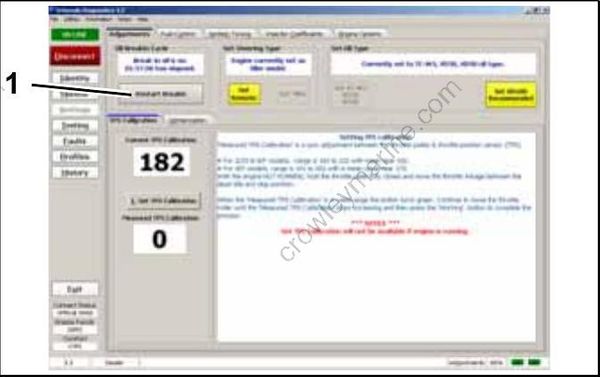
- Restart break-in
The operator must monitor the oil tank level to confirm oil consumption. This may require several hours of operation above idle.
